The Camino One Year on

Welcome to Roncesvalles

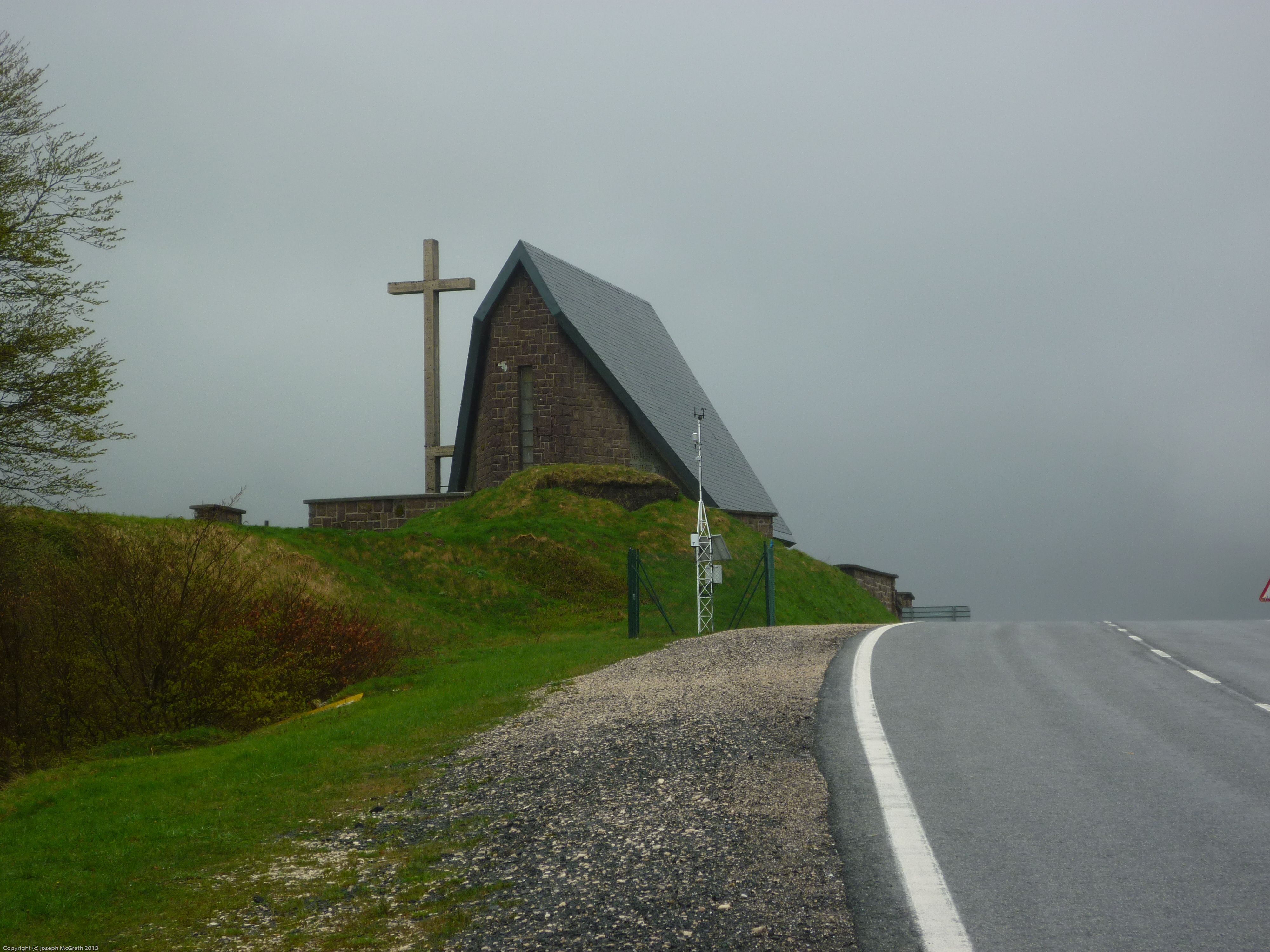
The church at the crest loomed out of the mist

It’s exactly one year ago that I started out from St. Jean pied de Port on the French side of the Pyrenees to walk to Santiago de Compostella. As regular readers of this blog will know, I never made it. This was, however, a day of triumph for me. I set out at seven o’clock in the morning into a rainy, dull morning and headed for the hills. I was unsure about this stretch, I was trying to get over the mountains to Roncesvalles in Spain. I felt this was my last chance to do so. Certainly it was my last chance before reaching the age of 65 and becoming officially ‘OLD’.

It is, at the time of writing, exactly one year ago that I walked across the Spanish border. By this time I had decided that taking the diversions suggested in the guidebook meant that I would be climbing up hills only to come back down again and that was a waste of the little stamina that I posessed. I decided to stick to the road. The Route Napoleon over the top had been closed the day before because of snow. The top was still enveloped in cloud and there was no chance of capturing the magnificent views from there, so I opted out of that route. I later found that I had made the right decision as the route was not fully open and several Pelegrinos had come a cropper on icy slopes.

After a short stop to eat some bread and drink some water I set off on the increasingly steep road. I was beginning to struggle under the weight of my haversack and was met with disappointment at each bend in the road to find, not the summit but another winding stretch. I don’t have the literary skills to describe the elation when the church at the top loomed out of the mist and I realised that the top was within my reach. I reached the hostel, exhausted, but with a real feeling of achievement.

I had successfully completed the first and most difficult stretch of my journey and I felt that I would easily finish the pilgrimage and reach Santiago de Compostella in triumph. Of course that was not to be. On the third day, the easiest walk in beautiful weather I had to drop out with pains in my chest.

One year on, how do I feel about my walk? Well my chest pains amounted to nothing at all. I still get them but they seem to be a muscular problem. When I set out I was concerned about my right hip as it had been causing me some pain. It never bothered me at all on the Camino. Today I am popping pain killers to counter the the pain in my worn hip. I’m not so bad that I need a replacement – yet but I certainly could not attempt the walk from St Jean today. My feelings were correct. That was my last chance to have a go at the Camino. I didn’t complete it but I learned so much about myself and the nature of salvation that it was worth every heavy step. If you have thought of walking the Camino I would encourage you to have a go.

If you would like to find out more about my short walk you can find a fuller account in my book “My Journey of Faith” availabe on Kindle. See my books page. I’ll continue to walk but on less adventurous routes.

My April Column – Full Text

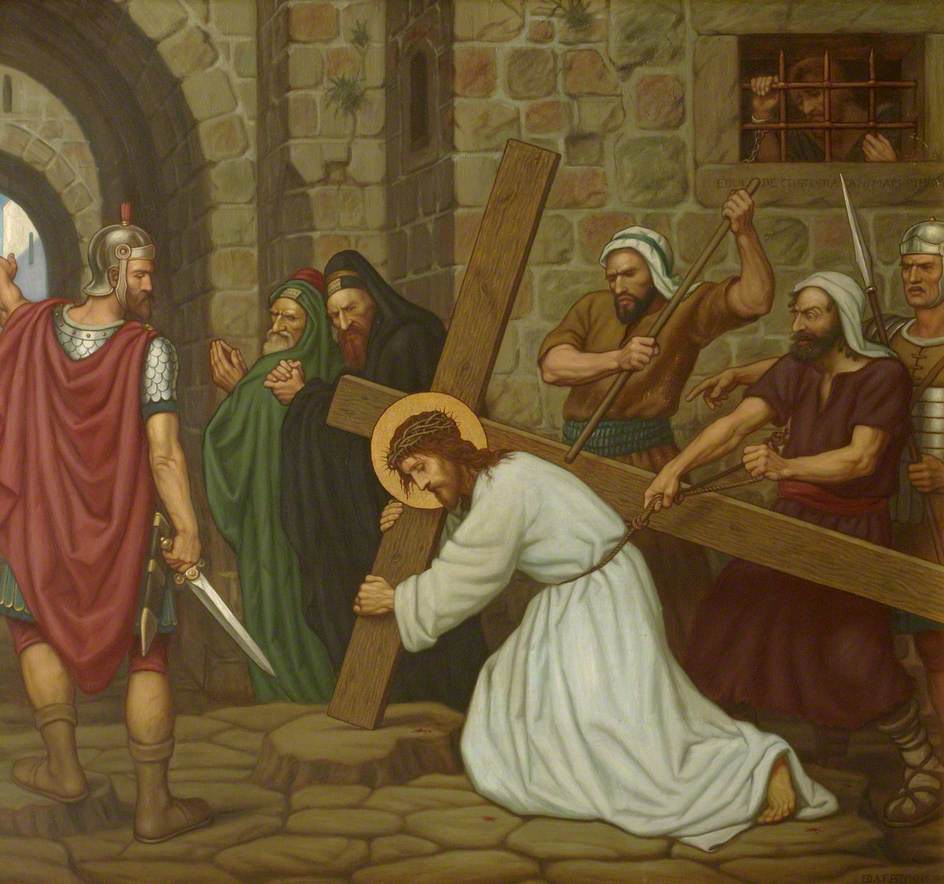
Jesus Meets His Mother

The fourth station on the Way of the Cross is where Jesus meets his mother. There is no mention of this in any of the gospels. I wonder why. Then it seems obvious, we know his mother was at the foot of the cross. She must have followed him all the way there.

Jesus has recovered from his fall. He is continuing his final journey, weakened but goaded on by the shouts and blow of his executioners. Then, struggling on, he lifts his head and sees his mother in the crowd. Their eyes meet. What are they thinking?

Mary is there, not by chance, but because she has followed her son. Less than a week ago he was welcomed to Jerusalem by cheering crowds waving palm fronds. Now, a few days later, things have changed completely. Did Mary understand what was happening or was she bewildered by the sudden change? How did she feel, seeing her only son, weak and bleeding, being led to a criminal’s death?

Mothers always seem to feel the pain their children experience. Anybody who has seen a toddler bump his head on a table and cry out in pain will remember the mother scooping him up, wishing to take the pain herself, and soothing the child. That never ends. Mothers continue to watch their children grow and experience the pains of growing. The mother feels their pains. When the child is too old to scoop up and comfort the mother is still there, comforting as best she can. Once a mother always a mother.

Mary must have been confused but I imagine she must have been remembering the prophesy of Simeon when Jesus was taken to the Temple.

You see this child: he is destined for the fall and the rising of many in Israel, destined to be a sign that is rejected – and a sword will pierce your own soul too – so that the secret thoughts of many may be laid bare.

Luke 2: 34, 35

Mary must have been feeling that sword as she stood in the crowd. Here, before her, is Jesus being rejected. The crowds that had welcomed him only days before were now baying for his blood. Mary knew that Jesus was here for a purpose. She must have realised that this was all part of his destiny. There is no mention of Mary screaming or making a fuss. She did not try to intervene. I wonder how I would react if my child was in that situation? Could I stand passively by and watch the torture and humiliation unfold?

I also wondered how Jesus felt when he saw his mother. He would see the pain in her face and he would know that, even though she was powerless to do anything, she was there for him. That’s what parents have to do. We have to be there, often powerless to help, just there as moral support. I suppose we all cause our parents worry and pain as we grow up. I’m sure I caused my mother a great deal of worry as I moved from one job to another and never applied for the job in the Post Office that she thought would bring me security. Through it all she was supportive in everything I did. That’s what I owe my children, my support and my acceptance of their decisions, even when I don’t understand the reasons.

Of course, when I think of this station I never consider the crowd. Who were these people who howled for his execution? Where were the supporters and the people he had helped? To put it bluntly, where would I have been if I had been in Jerusalem on that day? I like to think that I would have tried to help Jesus. If I look at my behaviour today I have to question that.

As a practicing Christian am I really following Jesus’ example? Do I behave like Jesus in my dealings with other people? How do I react when others attack the Church? Do I stand back and watch or do I speak up? Am I there for the stranger who is lost or in difficulty? How do I treat the people I don’t agree with? Am I happy to see them in difficulty or do I step forward and offer my help?

I recently viewed a Youtube video of a member of the Orange Lodge arguing for a NO vote in the Independence referendum. The comments from other viewers accused him of being a bigot who was not worth listening to. Nobody was considering the points he made. He was condemned for who he was rather than what he was saying. I was ashamed of the treatment he got. Would Jesus have reacted in that way? It is easier to be part of the mob than to speak out for justice.

The school I taught in before I retired had just that as its motto. Speak out for justice. What better advice could a catholic school give to its pupils? How many of us follow that advice? Do I speak out for justice or am I happy to see someone get their comeuppance? I suppose I need to remind myself that I meet Jesus in everyone I encounter. Do I see Jesus in the eyes of a beggar on the street? Do I see Jesus in the face of the convict being led off to start a long sentence?

Am I able to see Jesus in the illegal immigrant being flown home in handcuffs? Can I imagine that Jesus is to be found behind the balaclava on the pro-Russian protestor in Ukraine? You might argue that these are hard questions. You would be right. How could I imagine that you could find Jesus in someone you oppose? Well, that’s what Jesus could do. Think of the times he was seen in the company of the lowest of the low, the people most despised in society. Jesus could see worth in the worst of people. I must learn to do the same.

I must face up to the possibility that on current performance I could be one of the crowd. Perhaps I would have joined in the shouting, afraid to speak out for the innocent man and too ready to seek approval from the powerful elite. Would I be willing to suffer the disapproval of my friends and neighbours by saying they were wrong?

This is very hard but Jesus never promised that following him would be easy. Mary followed him and was there for him even at the worst of times. I think we are called on to do the same. We must be there for Jesus in his suffering. Where will we find Jesus in his suffering? Look around. Wherever we see the rejected people we see Jesus rejected. Wherever we see the criminal, jailed for his crimes, we see Jesus suffering with him. The sick, the homeless and the lonely are all opportunities for me to step out of the crowd, stop howling for Jesus’ execution and become a follower, helping the Jesus I find in unexpected places.

Joseph McGrath

My March Column – Full Text

The Third Station

Jesus falls under the weight of his cross

The Third Station: Jesus Falls The First Time

In this station we recall the first of three falls Jesus experiences on his journey. I looked through the Gospels but there is no mention of Jesus falling by any of the evangelists. Why do we think of Jesus falling and why three times?

I suppose it is reasonable to think that Jesus, in his weakened state, must have stumbled on the way through the city. The early pilgrims who followed the path that Jesus was led along must have realised from the rough nature of the paving that Jesus would have fallen and the falls have become incorporated into the way.

There must be more to it than that. There must be a message there somewhere. Three is a peculiar number. It was thought to have special powers by early people. It is the first triangular number and is used in folklore and early stories that have become fairy tales. There are three little pigs; the wicked witch tried to kill Snowwhite three times; there were three blind mice; the list goes on.

I tried to imagine a fall. What is it like to fall? I don’t need to imagine, I have fallen, an unpleasant experience. My wife and I were in Paris for a short break a few years ago. Our coach stopped to allow us to view the Eifel Tower. I had my good camera and ran across the road to get a good spot for a picture. In my haste I didn’t notice that the kerbstones were not all at the same height and I tripped. In trying to save my camera I landed heavily on the paved surface.

I was bleeding and shocked. A fall leaves its mark. The consequences of Adam’s fall left us in the perilous state we are born into, needing salvation, needing a Saviour. The link between ‘fall’ and ‘sin’ was brought home to me recently on Ash Wednesday. The Priest said, “Turn away from sin and be faithful to the Gospel”. He dobbed my forehead with ashes. This is a very positive message. In the past the message was “Remember man that thou art dust and into dust you shall return.” followed by a dusty looking mark on the forehead. The faint dusty mark was a good reminder of the dust I would return to.

When I got home I went to wash my hands and was shocked to see a big black mark on my forehead. This was no pale reminder of the dust I will return to. I was marked, marked as a sinner. Friends remarked that the priest had “really got you!” It stood out and reminded me that I really am a sinner. It was a bigger shock than the fall in Paris.

I realised that this was what the third station is about. We are sinners. If we are going along to the stations of the Cross, seeing ourselves as the good folk, not like those others who don’t appear, than here we are reminded that we are not as good as we like to think. We are the sinners Jesus came to save. We are all in this together, to use a contemporary phrase; we are here as a result of Adam’s fall. It is in our nature to sin. We were created with free will and we can choose to do good or evil. All too often we do not choose good.

This first fall reminds us that Jesus was fully man and experienced all the difficulties we are open to. He understands that we sometimes find ourselves in circumstances where we are prone to fall, to fall into sin. Jesus’ capacity for understanding sinners is the truly amazing feature of his life on earth. His sympathy for sinners shocked the right minded people of the day. The fact that he spent time with sinners and even dined with them seemed to mark him out as a sinner too. When Jesus forgave sins that really marked him out as a dodgy character.

At the first fall Jesus gets up again and carries on. He must have damaged himself, falling onto a rough path with the heavy cross on his back. His struggle is now harder, more painful. We too can get up again and carry on. We have the great gift of Jesus’ forgiveness in the sacrament of reconciliation to help us back on the road. What is there to stop us?

Well, in my case, probably pride, shame, embarrassment or some combination thereof. How can I go to confession and come away without that feeling that a great burden has been lifted from my shoulders? I’ve given a lot of thought to that question. The best answer I can find is that we don’t often encounter complete forgiveness in our human contacts. It’s out with our normal experience. My mistake is to forget that Jesus is not simply another human. He is also God.

All too often, I think, we try to make God like one of us. We should really try it the other way round. I should be trying to be like Jesus and see things the way Jesus sees them. When was the last time I looked down on someone? Who do I see when I look at other people?

I remember an account of a school visit by my Irish colleague when I was with Missio. She had a visiting nun from Uganda, Sister Fortunata. Fortunata was a big, unstoppable woman. My colleague Jackie took Fortunata to a local, Dublin primary school to give them an idea of how the missions worked in Uganda.

Fortunata asked the children if they had ever met Jesus. They answered that, of course, they had not. Fortunata told them to turn to the person next to them and say “Hello Jesus”. She impressed on them the fact that we meet Jesus in every person we meet. This was a great teaching point but Fortunata, by her nature, had to take things further. Everybody had to be addressed as Jesus.

All that day the school was filled with “Hello Jesus”, “Jesus, I like your new haircut”, “Jesus you are looking well today”.  The school remained in that uproar ‘till long after Fortunata had gone. I heard the head teacher nearly had a breakdown.

At the time I thought Fortunata was crackers. In fact she was dead right. How often do I remember that I meet Jesus in other people, in every other person? In this station we see Jesus as a broken and bleeding man in torn clothes being taken to die a shameful death. Would I have recognised him? Do I recognise him in the unfortunates that I see every day?

I have failed in this so far, but I have also learned that my failure is only a fall and I can get up again, even though that might be difficult, and start on the road again. This time I will try to remember that the people I meet are just people like me and if I look closely enough, look beyond the clothes and the wear and tear that life has brought on them, I might be able to see the face of Jesus.


Joseph McGrath


My February Column Published Today

Jesus carries his cross to Calvary

Jesus Carries His Cross

My latest column is published today in the Scottish Catholic Observer. The Way of The Cross. This month I look at the Second Station – Jesus caries his cross. What more is there to say about that? Get your copy this weekend in your local parish and find out.

Full text here next week for those who miss the rush and can’t get a copy.

The Way of the Cross 1

Strangers to Christianity often wonder at the symbolism we use. The cross is a reminder of Christ’s violent and ignominious death, a failure in human terms. Similarly, the way of the cross must seem strange to them. We follow the last steps of Jesus as He carries His cross to the place of execution. Why would we wish to remember that?

Of course, as Christians, we understand the significance of this event and we are charged to take up our cross and follow. The Stations of the Cross which we are familiar with originated in the Via Dolorosa followed by pilgrims to Jerusalem. They retraced the path Jesus followed to His crucifixion.

Today we are following a tradition which is reputed to have started with Saint Francis of Assisi who made this a devotion in churches. We don’t need to go to Jerusalem to retrace Our Lord’s last steps we can do it in our own parish. It is so much an accepted part of Catholic life that I have never given much thought to its origins or deeper meanings.

This time last year I was making my preparations for my attempt at the Camino, a testing pilgrimage. When I set off eventually I passed through Lourdes and had a passing thought about starting from there. The train moved off and the thought went. At the end of last year I returned to Lourdes for the feast of the Immaculate Conception, a less strenuous pilgrimage.

On that feast day we had Mass in the grotto followed by The Stations in the underground basilica. We were led by Father John Ahern and his commentary had a lasting effect on me. The basilica was dark and cold on that December morning. Perhaps the strange surroundings led me to think again about the Stations as a pilgrimage.

That’s where I’m going this year. I’m going to take each station in turn and see what I find. I hope you can come along.

The First Station – Jesus is condemned to death

I start by looking at what we are told in the Gospels. All four evangelists agree that Jesus was condemned to death by Pontius Pilate. They go to some length to show that Pilate was reluctant to do this. He said he could find no case against Jesus that merited death. The crowd applied pressure. They howled him down. They applied political threats. They claimed that Jesus’ claim to be a king was a threat to Caesar, Pilate’s boss.

Pilate reluctantly gave in and condemned Jesus to death. In Matthew’s gospel we learn that he washes his hands of Jesus’ blood. Matthew goes further to tell us that the people say “Let his blood be on us and our children.”

So who is guilty of Jesus’ death? The debate resurfaces from time to time. In recent years the Mel Gibson film “The Passion of The Christ” caused furore and accusations of anti-Semitism. Were the Jews to blame or was it the Romans? It is an interesting debate, but I think it misses the point. I was always taught that Jesus died for our sins. He died to redeem us. If there is any blame going then some of it must, surely come my way.

The focus of this station is not on who is to blame. We are asked to look at this situation and imagine what we would have done if we had been there. If I was one of the crowd would I have cried out “Crucify him!” just like the others? It might have proved to be a dangerous thing to do.

If I had been in Pontius Pilate’s place how would I have reacted? Pilate was a powerful man. He had a Roman army at his disposal. He could have sorted out the crowd easily. Pilate was governor to calm down Jerusalem. He didn’t want to stir up crowds. He knew Jesus was innocent and a victim of jealousy. Would I have acted differently? Would I stand up for truth in the face of displeasing my ruler and probably losing my job?

Well, that was then and this is today. It would be easy to say I would have been a man of principle and would have stood for justice. What would I do in a similar situation today? There are innocent people suffering and dying in unjust situations. In Africa there are poor farmers who will remain poor no matter how hard they work because the price of the tea or coffee they grow is decided by the dealers in the rich countries. I buy that tea and coffee. When am I standing up against injustice?

Asylum seekers in our country face inhuman treatment sometimes. I read today of an eighty four year old man in a detention centre for asylum seekers who died in handcuffs. Doctors had declared him to be unfit for detention or deportation but he died, having been in handcuffs for almost five hours. When did I stand up and speak out against inhuman treatment of people in my country?

Some might cite the abortion scandal in our country as another example of killing the innocent while we ignore it. In the light of these things I’m not sure that I could claim to act any differently than Pilate or the crowd who condemned Jesus. Perhaps that’s the point of the first station. It invites us to look, not at Pilate and the crowd, but at ourselves.

The Way of the Cross is a pilgrimage of sorts and it should enable me to see things in a different light. It should enable me to see myself more clearly, let me see who I really am. I think I must take stock and decide whether I want to be one of the crowd or stand up for justice.

Fortunately there are ways of taking action now that may not have been available in the past. If I want to take action against injustice I can join one of the many groups or organisations that combat injustice. I can become a campaigner with Justice and Peace or help organisations that work to help the poor like Mission Matters or Aid to the Church in need. I could volunteer to work for the poor with the Society of Saint Vincent De Paul.

There are lots of ways I could stand up for justice. One of the most effective ways is, of course, through prayer. Prayer must not be seen as an easy way out. Real prayer is not a quick Hail Mary for the poor. Real prayer for justice must be regular and unceasing. There are lots of prayer options for me. Perhaps I could look back to where I started, in Lourdes. The wee shops opposite the grotto are loaded down with rosaries, and for good reason. Regularly praying the rosary (not the mad dash through the decades) could provide me with an effective and powerful means to stand out from the crowd.

Just as importantly, I must become more observant. I should be able to spot injustice, be it at work, at home or in the public arena. I must become prepared to do something about it.

Joseph McGrath

My New Book On Kindle

Book Cover

Look out for this cover

My latest publication is now available on Kindle. My Journey of Faith pulls together my colum articles from 2013 with a bit more detail on my attempt on the Camino. It was inspired by Pope Benedict XVI and his ‘Year of Faith’.

It is going live now and should soon be available to borrow free for Premuim members of Amazon.

My New Series Starts Today

My monthly column in the Scottish Catholic Observer starts again with a new series on the Way of The Cross. This follows on from last year’s series on a Journey of Faith.

How much do you know about the Way of The Cross? In this series I’ll be looking at what meaning it holds for me. Why not join me every fourth fFriday in the month?

The full text will appear here next week, as usual.

My December Column – Full Text

Well, that was the Year of Faith. It’s over now and we can move on. Before we do I’d like to just look back on the year to see what it did for me, and possibly you. The Year of Faith was launched with some fanfare and lots of resources were set in place for us, much of that online. There were events and celebrations before it all went into the background.

So, when I look back, did it help me in my personal journey of faith? I looked into where my faith came from. That was easy; it came from my parents, my grandparents and the faith community I was born into. The faith was passed down to me, a bit like an Olympic torch (or should I say a Commonwealth Games Baton?). Now it’s up to me as a parent and, was a while ago, as a teacher to pass that same torch, that flame of faith on to others.

I found lots of resources online. I got a daily email from Read the Catechism in a Year’ and ‘Daily Catholic Quotes’. Between the avalanche of stuff that poured through my computer screen and the coverage in the Scottish Catholic Observer I was well resourced.

I found that faith was not just about believing in God but it was much more. My faith is a power in my life and it is up to me to be open to this wonderful gift. It is something that I have to nurture and grow for my good and for the community of faith as a whole. I need to see if I can get my faith to be as big as a mustard seed. Now growing things was never my strong point as anyone who looks at my garden will tell you. So how can I nourish my faith?

The answer to that is, again, simple. The sacraments exist to do just that. It’s up to me to make more use of the sacraments and to avoid falling into the trap of treating them as routine. When I made my First Communion it was a big thing. All smartly dressed, cleaned and polished. This was Jesus coming to me. Why should First Communion be taken more seriously than the second, third or five hundredth communion? I must strive to regain that sense of awe that I had for the sacraments as a child. I need to remember just how wonderful they are.

Our new Holy Father has been a great guide and inspiration. He has reminded me of the need to concentrate on the fundamentals of Christ’s teaching and not to get bogged down in the rules. The rules are important but we must never let them get in the way of the essential message ‘love thy neighbour’. That’s another thing I’ve realised this year. My faith is not just about me. It is about how I behave towards other people. Is my focus on myself or am I thinking of others? Christ’s focus was always on others. I think that is a clear message for all of us.

Now, things have changed over the years in the Church. I can remember when we had parish retreats, class retreats and even evening retreats. These gave us opportunities to step aside from the ‘production line’ that is daily life and take time to spend in contemplation. I experienced retreats where we were expertly guided to find that peace where God’s message for us becomes clearer. These don’t seem to be so popular today. There is a need in all of us for a guided retreat.

I recently came across a book by a Jesuit priest which attempts to guide us through a DIY retreat. The book is called ‘Together on Retreat’ written by Fr. James Martin SJ. I bought it as an e-book on my Kindle. I’ve just started using it and I’m finding it very helpful. It’s a bit like having an expert in your pocket to help with your spiritual life.

The basis of the retreat is, of course, prayer. Father Martin started off by describing some different approaches to prayer. Let’s face it, if I want to get on better with God then I need to converse with Him. Not just recite prayers, but open up to Him about how I find myself at that moment and look out for His answer. A few months ago I mentioned my problems of being distracted in Mass. Fr. Martin gave me a deeper insight into why that might be. He pointed out that sometimes God pops thoughts into your head, not as a distraction, but to draw your attention to some issue you need to deal with. My attitude to distractions has changed for the better.

As part of my journey of faith I decided on a real journey. I went to France to start my personal pilgrimage, walking the Camino. I started my journey by train, travelling to London, on to Paris and then overnight to Bayonne and up to Saint Jean Pied de Port. On the overnight train I met a German who was doing his journey in stages. He alighted in Lourdes to continue on foot. I considered getting off there myself, but didn’t. I only managed to walk three days before having to give up with back problems.

I did learn a lot about myself and my faith on the journey. As I write this I’m preparing to go off again, this time to Lourdes for the 8th December celebration. Strangely enough, my flight takes me into Bilbao to continue by bus to Lourdes. I passed through Bilbao on my way home from the Camino. Now I’m going in reverse to Lourdes. Perhaps that is where I should have been going in the first place. This time I will not be alone. My wife is coming along to keep me out of trouble.

That has taught me another lesson, it is never finished when you think it is. My pilgrimage will go on. In the same way the year of Faith will go on. That year was just to get us started. We are all on our Journey of Faith. I recently came across a pastoral letter from the Bishop of Arundel and Brighton, Rt. Rev Kieran Conry, He was reflecting on what we might have achieved in this Year of Faith. In it I found this wonderful quote.

In the document on revelation in the Second Vatican Council, ………… faith is seen not as the communication and reception of facts, but the giving of God himself, and our response is not an intellectual response, but, the document says, “by faith man freely commits his entire self to God.” In other words our faith is a personal response to God’s love and an acceptance of that offer of God’s friendship.

There we have it in a nutshell, our journey of faith is not a journey to a place. It is a journey that must take us beyond ourselves and lead us to place ourselves entirely at God’s disposal, to do with as He wishes. We must take our free will and choose, freely, to place it at God’s feet. Jesus put himself entirely at the service of the Father. We must, in our various ways, do the same.

The year of Faith is not the end; it is the beginning of the life of Faith. There can be no going back now. I’ll be following ‘Read The Gospels in a Year’ see the link below.

Joseph McGrath

Note: Fr. Martin’s Book ‘Together on Retreat’ is available on Kindle from Amazon.

Read The Gospels in a Year – sign up at  http://flocknote.com/gospel
Bumper Christmas Edition – my Column

Observer Logo

The bumper Christmas and New Year edition of The Scottish Catholic Observer is out today. It carries my final column of this series – looking back at the Year of Faith. But, this is a bumber edition and also has columns from Peter Kearney, Hugh McLoughlin, John Deighan, Fr. Eddie McGhee, Gerald Warner, Kevin McKenna, Richard Purden, Mary McGinty, Andreas Wolff, John Newton, Joe Bradley and SCIAF. There is a story from Cath Docherty and a pullout section – “2013 A Reflection”.

All that for £2 – who can afford to miss that? If you do then you will find the full text of my column here next week. But, don’t wait – get your copy this weekend.