My September column: The Ninth Station

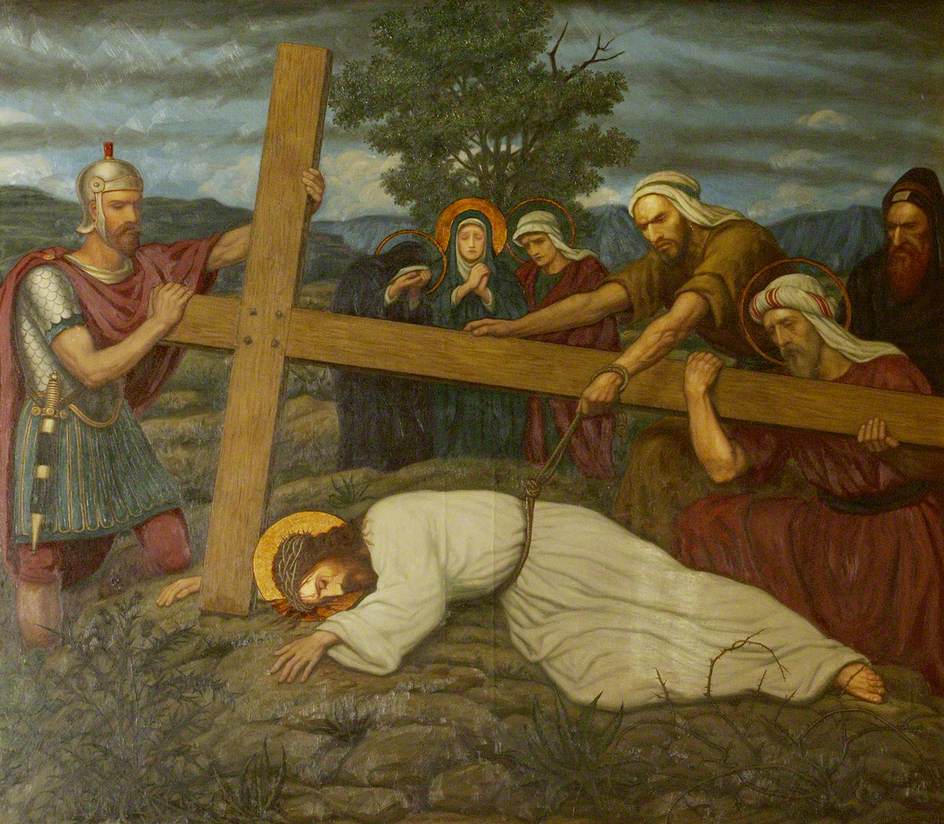
The ninth Station on the Way of the Cross;- Jesus Falls the Third Time.

The Third Fall

The Third Fall

Why is this significant? Why did he fall only three times? Why did he get up again?

For my thoughts on this mystery get your copy of the Scottish Catholic Observer this weekend. It’s out today. My column should be there.

If you are away on business or holiday or still have your head tucked under the blankets duvet afraid to find out the result of the referendum then the full text will appear here next week. The paper is better though with so many other interesting writers. (Should I have left out ‘other’?).

The Way of the Cross -8 My August Column

The weeping women

Weep not for me

Jesus meets the women of Jerusalem

In this series of articles I’m looking at the way of the Cross and I’m trying to find the meaning behind it; the message for us. This is a curious incident on that final journey. Who were these women/ Why were they weeping and why does Jesus speak to them in the way he does? It’s very strange and it needs looking into.

I looked into the gospel accounts to see what I could find there. The only mention of this comes in Luke’s gospel.

Large numbers of people followed him, and of women too, who mourned and lamented for him. But Jesus turned to them and said, ’Daughters of Jerusalem, do not weep for me; weep rather for yourselves and for your children. For the days will surely come when people will say, “Happy are those who are barren, the wombs that have never borne, the breasts that have never suckled!” Then they will begin to say to the mountains, “Fall on us!”; to the hills, “Cover us!” For if men use the green wood like this, what will happen when it is dry?’

Luke 23: 27, 31

The other three evangelists do not mention this incident. Why has Luke picked this out? He must have recognised an important message in this passage. The women in the passage are not the women who followed Jesus from Galilee. They are women of Jerusalem. If they are not followers why are they weeping and why does Jesus seem to discount their sorrow?

The question is one of ritual. Death has many rituals in different societies. In Jewish tradition women would be hired to come and weep and wail at funerals to set the sad, sombre tone of the occasion. This harks back to the story of Rachel whose tears prompted God’s forgiveness. Rituals like this are not uncommon in many societies. In Africa there are many tribes where wailing women are a matter of course.

I recall a story from my friend Father Pat McGuire who was on his first mission station in Ghana when he had to officiate at a funeral. The dead man’s widow jumped into the grave to be with her husband and could not be persuaded to come out. At a loss, Father Pat turned to a local priest for advice. He was told to start filling in the grave. When the first spade of earth was put in the woman jumped out. She was following a local ritual.

This may seem strange to us but we do similar things. Do you remember the film Oliver? Oliver was sold to an undertaker and dressed in black with a top hat, a mummer to precede the hearse and set a sad tone. We are still bound by funeral rituals today. We wear black. We have solemn faces, bells toll a solemn message of sadness. Yet, as Christians, we believe that death is the start of our new life in heaven; surely a happy occasion?

Rituals around death are changing in our society as we reject religion and need something in its place. I remember watching the funeral of Princess Diana and being amazed when people began throwing roses on to the hearse. Laying bunches of flowers, teddy bears or football tops on railings or at the roadside has become a ritual to mark the death of a loved one or even someone we barely knew. People are searching for something to replace a religious ritual. Perhaps the religious ritual really held no great meaning for them in the first place.

I am writing this while we are celebrating (?) the start of the First World War, the Great War as the media are calling it again. We have solemn ceremonies of rembrance of those who dies one hundred years ago. There seems to be little remembrance of those politicians who failed to avert a war in the first place. History shows little evidence of lessons learnt from the slaughter as we have managed to keep fighting wars where there need be none.

Is this false ritual what Jesus was referring to when he told the women not to weep for him? The ritual can hide the truth. Jesus’ words refer the women to another part of the Torah, our old testament, where in Jeremiah it says,

You there! Call the mourning women! Let them come! Send for those who are best at it! let them come! Let them lose no time in raising the lament for us! Let our eyes rain tears, our eyelids run with weeping! Yes, the wail is to be heard from Zion, what ruin is ours, what utter shame!

Jeremiah 9:16,19


This is in the face of the punishment that God is to wreak on the Israelites for forsaking the law.The passage about calling on the mountains to fall on us is a reference to another scriptural passage. This one is from Hosea 10:8 warning the Israelites of the punishment God will mete out for their unfaithfulness. Perhaps Jesus is warning the Jews of what is to befall them after rejecting him as the Messiah.

Jesus is the green wood in the quote. He brought the completion of the covenant between God and man a new covenant. The Jews rejected him and stuck with the dry wood, the incomplete covenant. This would not be immediately obvious to the people. After the crucifixion the Jewish religion continued and does to this day. Christianity started small and grew slowly.

The message in Luke’s gospel is really one for us. He is warning us about adopting rituals which, though not bad in themselves, can hide the real message. What do I mean by that? Let’s look at ritual in our Christian lives. Going to mass on a Sunday is a good place to start.

When I was a boy (not really that long ago, surely) we were taught that the obligation was to assist at the sacrifice of the mass. That is a wee bit more than just being there. At the consecration we are witnessing something extraordinary. The bread and wine becomes the second person of the Trinity. Lights don’t flash. There is no booming voice from heaven. Never the less we come into the presence of Jesus, our saviour. This is impossible for us to understand fully. It requires our belief. How do we react to this?

Reactions vary. Some people talk through this part of the mass. Some read the parish bulletin. Some kneel and appear devout but might be thinking about something else. Some are praying in the presence of the Lord. I’m not making any judgements here. I’m just admitting that the ritual sometimes does not highlight the importance of the moment but can fool us (me included) into thinking we have got it right. If we are not offering ourselves with the bread and wine, if we are not joining in the sacrifice at the consecration then we are missing the point.

The rituals are good. They are the signposts that can keep us on the right track, alert us to something important. When we forget to recognise what the ritual is alerting us to then we have lost the plot. We are like the weeping women. The Pharisees were hot on ritual and you know what Jesus thought of them.

This is not about ‘going to communion’ and then carrying on with things as normal. This is our opportunity to accept Jesus into our lives and give that life to him in our sacrifice. We should be going out of church on a mission. We should be out to change the world, starting small, growing slowly. Changing ourselves and becoming an influence on others by our example.

In this station I have learned something Luke wanted to tell us about ritual. We must be able to recognise Jesus there and be alert to his presence in our lives.


Joseph McGrath

The Sixth Station: Veronica Wipes the Face of Jesus

The Sixth Station

Veronica Wipes The Face of Jesus


This month I’m looking at the sixth station, Veronica wipes the face of Jesus. This is a really puzzling station. In our story of Jesus men seem to get the main parts. Peter gets to be the head of the Church. John gets called the beloved. You can understand how people see the Church as a man’s world with women in the back ground. I’ll not get into the discussion on woman’s place in the Church, not today anyway.


This station gives us pause for thought if we think women have no prominence in our story. We have been considering the final journey of Jesus as he walked to his death. The scene is one of brutality, oppression and fear. Where are Jesus’ faithful companions? One of them has betrayed him and the others have run off. Jesus is struggling under the weight of the cross, his loss of blood so weakening him that Simon has been pressganged in to assist him. The crowd is shouting abuse and the guards are pushing them back. Into the middle of this Veronica forces her way through the crowd, ignores the guards and places a towel on the holy face. The face is streaked with blood from the wounds on his head. Veronica absorbs the blood on the towel to give a little comfort to Jesus. As she is pushed away she is left with the imprint of the holy face in blood.


I have no scriptural evidence for this but it is traditional. It is interesting to note that the name Veronica comes from the Greek icon meaning image and the Latin vero meaning true; the true image. The tradition seems to have come from the Eastern Church and became popular in the Roman rite about a thousand years ago. I’m more concerned about the message this story has for me than the history.


The first thing that strikes me is the courage displayed by Veronica. Many Jews had become followers of Jesus, some of them prominent like Nicodemus. Yet even prominent men were afraid to come forward to intercede. It was this lone woman who broke through the crowd and ignored the soldiers to bring some small relief to Jesus. The amazing thing is that she got away with it. Why did she act in this way?


I have no doubt that she was inspired by the Holy Spirit. There lies the first message. When the Holy Spirit moves you, you have nothing to fear. You will succeed. Now I had always imagined that the Holy Spirit would act through the Apostles, their successors in the Church and the saints. Veronica was just a wee wummin as they might say in Glasgow. She was not one of the elite; a bit like you and me. The message is clear. Be prepared to act as an instrument of the Holy Spirit. As ordinary people we can and will be called upon to act.


It may not be in a dramatic way like Veronica but in a small way. It might be to give that kind word to a stranger that gives them encouragement to carry on in a difficult situation or you might be moved to speak out against an injustice. The words just come to you. I remember Magnus MacFarlane Barrow describing how he came to found Mary’s Meals. He was just an ordinary young man, too shy to continue his university course who found himself starting a charity. He didn’t recognise what was happening at first but when he did he followed the Spirit. You know the rest.


The second message I get from this station is about the role of women in the Church. Not just women but all of us ordinary people. Critics of the Church often point out that we are a church of men and women are only good for making the tea. I think that is to fail to see how the Church works. It is true that our priests are men and the hierarchy is exclusively male. However, the vast bulk of the Church is not comprised of clergy and religious.


The Spirit acts through all of us. I think of the hierarchy as the management, the priests as specialists who alone can bring us to Christ through the Eucharist and the rest of us as the workforce whose job it is to get on with the work. The Church is not a club we join, pay our dues and draw the benefits. The Church is a way of life, new life in Christ.


Now I can hear the voice of reason tut tutting in the background. That’s all very well but we have lives to lead, families to look after, work to go to. We live in this society and we must fit in. We go to mass; we say our prayers. What more do you want?


I’ll let Veronica answer that. I’m sure she prayed and fulfilled all the requirements of the Jewish faith. Veronica did not stop there and she certainly did not fit in. She didn’t just stand out from the crowd; she elbowed her way through it. Do I stand out from the crowd or do I just try to blend in so that nobody will notice me? Veronica has shown us a great example. What she did was just a simple thing, mopping the face of a man in pain. The thing is, she did it publicly, her actions in stark contrast to the baying of the crowd. We don’t need to fight the world, we just need to be seen to live as Christ taught us and be a living example for those who don’t share our values. It takes a little courage to stand out. Where could I find the strength to live like that? I’ll have to double my prayers to the Holy Spirit.


The last message I see in this station is about the image that was left on the cloth Veronica used. At school I learned that Jesus left this image of his face as a reward for Veronica’s kindness. As Christians we are all seeking the face of Jesus. There are all sorts of pictures made by great artists but none of them is the real face. It’s not uncommon for great leaders to have their face shown to everyone. Kings, queens and presidents all have their image in the newspapers and on television.


Jesus is not going to appear on the box one night as we sit down to watch the news. If we want to see his face we must seek it out. I feel I need to take a leaf out of her book. I should be living my life as a true follower of Christ. If Christ’s teaching is at odds with the norms of my society then my life should reflect his teaching and be seen to do so. Do I meet the beggar is the same way Christ did? Do I speak out against falsehood and wrongdoing?


Perhaps if I try to live more like Christ and see people as he did, not just strangers but fellow children of God, loved by God just as much as I am, then I might just reach my goal and see God, face to face as it were. I’m fairly sure that if I continue to ignore my responsibilities to my neighbour then I might end up seeing a face I’d rather avoid.


How Do You Measure Up to a Wee Wummin?

My June column will be published today in the Scottish Catholic Observer. It concerns the Sixth Station of the Way of the Cross. Veronica wipes the face of Jesus.

What would you have done in her place? Buy the paper this weekend and see what I have to say.

My May Column – Simon of Cyrene

Way of the Cross 5


Simon of Cyrene is made to carry the cross.


Simon had come into Jerusalem, presumably to celebrate the Passover. He is mentioned in the gospels of Matthew, Mark and Luke. In Mark’s gospel he is named as the father of Alexander and Rufus. I assume from that he was known to the disciples.


Simon was probably expecting to spend the festival with friends and enjoy the event in good company. He could never have expected that he would be accompanying a condemned man and playing a central role in his final walk to his death. This would be a very public role. He would not be in the background but would walk step by step with the figure of abuse. Simon would share the abuse.


Simon had come into the city for the Passover. He would expect to share in the Passover meal and the rituals it involved. He would spend the evening with his friends enjoying the singing, storytelling and catching up with all the latest news. Perhaps he expected to learn about the events surrounding Jesus. Instead he found himself right at the centre of the story.


I wondered why Simon was at the centre of this story. He was not one of the disciples. We never heard of him before this and he was never mentioned again. Why is he shoved in front of us so boldly? Who is he? Then it struck me. Simon is really me, or perhaps a model for me. He found himself in a difficult situation, much against his will, but he got on with it and carried the cross.


You must have found yourself in situations like that. You are busy; you have plans. Then you are called upon to help someone. Perhaps they ask for help or someone directs them to you. You may not know them or worse, you do know them and you don’t get on with them. What do you do? Do you help or do you walk away? Why should you be put in this situation?


You are busy. I know I am. Just ask my wife; when there is cleaning to do or dishes to put away then I usually have something important to do. There is so much to do and so little time. Sometimes we are too busy to get involved with other people, sometimes even too busy for God. Perhaps we don’t pray as often as we should. Mind you, there are those times when a prayer springs to our lips moments of danger or times of worry. We pray for help from the only really reliable source, God.


What do we expect in answer to our prayers? When that young guy in his sporty car cuts in in front of us and we feel that a collision is imminent we instinctively call on God. What are we expecting? Is it angel Gabriel swooping down and pulling the car away? When we are confronted with a difficult situation and pray for help do we expect God to pop in and sort it out? That’s not how it works.


What usually happens is that someone comes along and we find a solution. God answers our prayers by using other people to help us. The person who helps usually does not realise that they have been used in this way. It’s not unnatural to feel put out at having to help someone when you are busy. Even Jesus experienced this.


In St. John’s gospel we read about Jesus and his mother at a wedding in Cana in Galilee. As we all remember, the wine ran out causing a worry for the family.

When they ran out of wine, since the wine provided for the wedding was all finished,the mother of Jesus said to him, “they have no wine”. Jesus said, “Woman, why turn to me? My hour has not come yet.”

John 2: 3,4

Jesus found himself in the situation that many of us encounter. Despite his reluctance he sorts out the problem. Admittedly, I would be at a loss in turning water into wine, but rest assured we are never called on to help when we are not capable of sorting the problem out.


Simon’s example is, perhaps, an extreme one. He was made to suffer the abuse along with Jesus. Sometimes we can suffer similarly when helping someone who is regarded as bad or otherwise unworthy. How often have you heard someone comment on the lawyer defending a notorious murderer saying “How could they defend someone like that. They should be ashamed.” Defence lawyers can suffer in the same way as Simon did.


The same sort of thing can happen with those who help asylum seekers or speak up for human rights. They become associated with a group who might be looked down on. I recall speaking with volunteers who worked with the Society of Saint Vincent de Paul. They were finding it difficult to recruit new members. They found that people would happily give money to help but didn’t want to be associated with the poor.


So, if Simon is a model for me, what sort of changes should I be looking to make in my life and my attitude to others? I think I need to start by asking myself if I am really willing to help others. Am I up for carrying the cross? When someone is in need of help do I notice? Am I blissfully unaware of their plight?


I mentioned the Society of Saint Vincent de Paul. The volunteers there, by joining the society, have made room in their lives for the problems faced by other people. How will I make room in my life for others? There are plenty of organisations in need of volunteers who are willing to help others.


Now you might complain that I am suggesting that we all need to change our lives. You would be absolutely right. I think that is what being a Christian is all about. Jesus came to change the world. He created a Church to carry on his work. So to be a Christian is to be someone who wants to make changes. The changes must start with ourselves.


A few years ago on a visit to Uganda our host told us we would be given a tribal name. This is common practice there. One woman followed us around and observed how we acted and what we did and at the end of the week there she gave us our tribal names. My name was Atwoki. I was told this meant ‘Leader’.


On further travels in the country we were asked for our tribal names and I responded with Atwoki. The reaction that brought convinced me that Atwoki did not mean ‘Leader’. Rather I suspect it means something like ‘grumpy wee bald guy’.


There’s not much I can do about the bald bit but I’m sure I could be less grumpy. When we all meet together in front of the throne of God and face our final judgement we might be assigned a name that reflects our performance here during our life. I’d be ashamed to stand there and be exposed as someone like Atwoki who is self-important. I’d much rather be seen like Simon who helped Jesus carry his cross.


Joseph McGrath


My May Column – The Fifth Station

My May column should be published this weekend in the Scottish Catholic Observer.

This month I look at Simon of Cyrene, who was he and why should Itake any notice of him?

Get your copy from your local parish this weekend. The full text will be published here next week for those who miss the opportunity this weekend or where the paper is sold out – again.

My December Column – Full Text

Well, that was the Year of Faith. It’s over now and we can move on. Before we do I’d like to just look back on the year to see what it did for me, and possibly you. The Year of Faith was launched with some fanfare and lots of resources were set in place for us, much of that online. There were events and celebrations before it all went into the background.

So, when I look back, did it help me in my personal journey of faith? I looked into where my faith came from. That was easy; it came from my parents, my grandparents and the faith community I was born into. The faith was passed down to me, a bit like an Olympic torch (or should I say a Commonwealth Games Baton?). Now it’s up to me as a parent and, was a while ago, as a teacher to pass that same torch, that flame of faith on to others.

I found lots of resources online. I got a daily email from Read the Catechism in a Year’ and ‘Daily Catholic Quotes’. Between the avalanche of stuff that poured through my computer screen and the coverage in the Scottish Catholic Observer I was well resourced.

I found that faith was not just about believing in God but it was much more. My faith is a power in my life and it is up to me to be open to this wonderful gift. It is something that I have to nurture and grow for my good and for the community of faith as a whole. I need to see if I can get my faith to be as big as a mustard seed. Now growing things was never my strong point as anyone who looks at my garden will tell you. So how can I nourish my faith?

The answer to that is, again, simple. The sacraments exist to do just that. It’s up to me to make more use of the sacraments and to avoid falling into the trap of treating them as routine. When I made my First Communion it was a big thing. All smartly dressed, cleaned and polished. This was Jesus coming to me. Why should First Communion be taken more seriously than the second, third or five hundredth communion? I must strive to regain that sense of awe that I had for the sacraments as a child. I need to remember just how wonderful they are.

Our new Holy Father has been a great guide and inspiration. He has reminded me of the need to concentrate on the fundamentals of Christ’s teaching and not to get bogged down in the rules. The rules are important but we must never let them get in the way of the essential message ‘love thy neighbour’. That’s another thing I’ve realised this year. My faith is not just about me. It is about how I behave towards other people. Is my focus on myself or am I thinking of others? Christ’s focus was always on others. I think that is a clear message for all of us.

Now, things have changed over the years in the Church. I can remember when we had parish retreats, class retreats and even evening retreats. These gave us opportunities to step aside from the ‘production line’ that is daily life and take time to spend in contemplation. I experienced retreats where we were expertly guided to find that peace where God’s message for us becomes clearer. These don’t seem to be so popular today. There is a need in all of us for a guided retreat.

I recently came across a book by a Jesuit priest which attempts to guide us through a DIY retreat. The book is called ‘Together on Retreat’ written by Fr. James Martin SJ. I bought it as an e-book on my Kindle. I’ve just started using it and I’m finding it very helpful. It’s a bit like having an expert in your pocket to help with your spiritual life.

The basis of the retreat is, of course, prayer. Father Martin started off by describing some different approaches to prayer. Let’s face it, if I want to get on better with God then I need to converse with Him. Not just recite prayers, but open up to Him about how I find myself at that moment and look out for His answer. A few months ago I mentioned my problems of being distracted in Mass. Fr. Martin gave me a deeper insight into why that might be. He pointed out that sometimes God pops thoughts into your head, not as a distraction, but to draw your attention to some issue you need to deal with. My attitude to distractions has changed for the better.

As part of my journey of faith I decided on a real journey. I went to France to start my personal pilgrimage, walking the Camino. I started my journey by train, travelling to London, on to Paris and then overnight to Bayonne and up to Saint Jean Pied de Port. On the overnight train I met a German who was doing his journey in stages. He alighted in Lourdes to continue on foot. I considered getting off there myself, but didn’t. I only managed to walk three days before having to give up with back problems.

I did learn a lot about myself and my faith on the journey. As I write this I’m preparing to go off again, this time to Lourdes for the 8th December celebration. Strangely enough, my flight takes me into Bilbao to continue by bus to Lourdes. I passed through Bilbao on my way home from the Camino. Now I’m going in reverse to Lourdes. Perhaps that is where I should have been going in the first place. This time I will not be alone. My wife is coming along to keep me out of trouble.

That has taught me another lesson, it is never finished when you think it is. My pilgrimage will go on. In the same way the year of Faith will go on. That year was just to get us started. We are all on our Journey of Faith. I recently came across a pastoral letter from the Bishop of Arundel and Brighton, Rt. Rev Kieran Conry, He was reflecting on what we might have achieved in this Year of Faith. In it I found this wonderful quote.

In the document on revelation in the Second Vatican Council, ………… faith is seen not as the communication and reception of facts, but the giving of God himself, and our response is not an intellectual response, but, the document says, “by faith man freely commits his entire self to God.” In other words our faith is a personal response to God’s love and an acceptance of that offer of God’s friendship.

There we have it in a nutshell, our journey of faith is not a journey to a place. It is a journey that must take us beyond ourselves and lead us to place ourselves entirely at God’s disposal, to do with as He wishes. We must take our free will and choose, freely, to place it at God’s feet. Jesus put himself entirely at the service of the Father. We must, in our various ways, do the same.

The year of Faith is not the end; it is the beginning of the life of Faith. There can be no going back now. I’ll be following ‘Read The Gospels in a Year’ see the link below.

Joseph McGrath

Note: Fr. Martin’s Book ‘Together on Retreat’ is available on Kindle from Amazon.

Read The Gospels in a Year – sign up at  http://flocknote.com/gospel
Bumper Christmas Edition – my Column

Observer Logo

The bumper Christmas and New Year edition of The Scottish Catholic Observer is out today. It carries my final column of this series – looking back at the Year of Faith. But, this is a bumber edition and also has columns from Peter Kearney, Hugh McLoughlin, John Deighan, Fr. Eddie McGhee, Gerald Warner, Kevin McKenna, Richard Purden, Mary McGinty, Andreas Wolff, John Newton, Joe Bradley and SCIAF. There is a story from Cath Docherty and a pullout section – “2013 A Reflection”.

All that for £2 – who can afford to miss that? If you do then you will find the full text of my column here next week. But, don’t wait – get your copy this weekend.