My March Column – Full Text

The Third Station

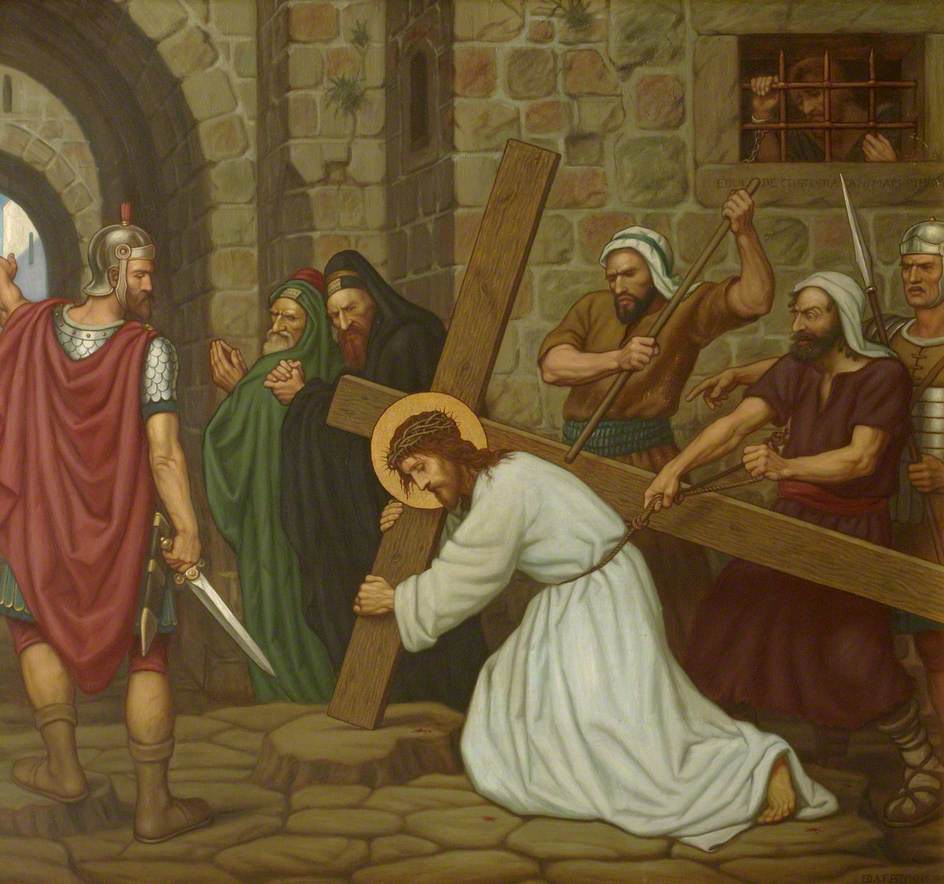
Jesus falls under the weight of his cross

The Third Station: Jesus Falls The First Time

In this station we recall the first of three falls Jesus experiences on his journey. I looked through the Gospels but there is no mention of Jesus falling by any of the evangelists. Why do we think of Jesus falling and why three times?

I suppose it is reasonable to think that Jesus, in his weakened state, must have stumbled on the way through the city. The early pilgrims who followed the path that Jesus was led along must have realised from the rough nature of the paving that Jesus would have fallen and the falls have become incorporated into the way.

There must be more to it than that. There must be a message there somewhere. Three is a peculiar number. It was thought to have special powers by early people. It is the first triangular number and is used in folklore and early stories that have become fairy tales. There are three little pigs; the wicked witch tried to kill Snowwhite three times; there were three blind mice; the list goes on.

I tried to imagine a fall. What is it like to fall? I don’t need to imagine, I have fallen, an unpleasant experience. My wife and I were in Paris for a short break a few years ago. Our coach stopped to allow us to view the Eifel Tower. I had my good camera and ran across the road to get a good spot for a picture. In my haste I didn’t notice that the kerbstones were not all at the same height and I tripped. In trying to save my camera I landed heavily on the paved surface.

I was bleeding and shocked. A fall leaves its mark. The consequences of Adam’s fall left us in the perilous state we are born into, needing salvation, needing a Saviour. The link between ‘fall’ and ‘sin’ was brought home to me recently on Ash Wednesday. The Priest said, “Turn away from sin and be faithful to the Gospel”. He dobbed my forehead with ashes. This is a very positive message. In the past the message was “Remember man that thou art dust and into dust you shall return.” followed by a dusty looking mark on the forehead. The faint dusty mark was a good reminder of the dust I would return to.

When I got home I went to wash my hands and was shocked to see a big black mark on my forehead. This was no pale reminder of the dust I will return to. I was marked, marked as a sinner. Friends remarked that the priest had “really got you!” It stood out and reminded me that I really am a sinner. It was a bigger shock than the fall in Paris.

I realised that this was what the third station is about. We are sinners. If we are going along to the stations of the Cross, seeing ourselves as the good folk, not like those others who don’t appear, than here we are reminded that we are not as good as we like to think. We are the sinners Jesus came to save. We are all in this together, to use a contemporary phrase; we are here as a result of Adam’s fall. It is in our nature to sin. We were created with free will and we can choose to do good or evil. All too often we do not choose good.

This first fall reminds us that Jesus was fully man and experienced all the difficulties we are open to. He understands that we sometimes find ourselves in circumstances where we are prone to fall, to fall into sin. Jesus’ capacity for understanding sinners is the truly amazing feature of his life on earth. His sympathy for sinners shocked the right minded people of the day. The fact that he spent time with sinners and even dined with them seemed to mark him out as a sinner too. When Jesus forgave sins that really marked him out as a dodgy character.

At the first fall Jesus gets up again and carries on. He must have damaged himself, falling onto a rough path with the heavy cross on his back. His struggle is now harder, more painful. We too can get up again and carry on. We have the great gift of Jesus’ forgiveness in the sacrament of reconciliation to help us back on the road. What is there to stop us?

Well, in my case, probably pride, shame, embarrassment or some combination thereof. How can I go to confession and come away without that feeling that a great burden has been lifted from my shoulders? I’ve given a lot of thought to that question. The best answer I can find is that we don’t often encounter complete forgiveness in our human contacts. It’s out with our normal experience. My mistake is to forget that Jesus is not simply another human. He is also God.

All too often, I think, we try to make God like one of us. We should really try it the other way round. I should be trying to be like Jesus and see things the way Jesus sees them. When was the last time I looked down on someone? Who do I see when I look at other people?

I remember an account of a school visit by my Irish colleague when I was with Missio. She had a visiting nun from Uganda, Sister Fortunata. Fortunata was a big, unstoppable woman. My colleague Jackie took Fortunata to a local, Dublin primary school to give them an idea of how the missions worked in Uganda.

Fortunata asked the children if they had ever met Jesus. They answered that, of course, they had not. Fortunata told them to turn to the person next to them and say “Hello Jesus”. She impressed on them the fact that we meet Jesus in every person we meet. This was a great teaching point but Fortunata, by her nature, had to take things further. Everybody had to be addressed as Jesus.

All that day the school was filled with “Hello Jesus”, “Jesus, I like your new haircut”, “Jesus you are looking well today”.  The school remained in that uproar ‘till long after Fortunata had gone. I heard the head teacher nearly had a breakdown.

At the time I thought Fortunata was crackers. In fact she was dead right. How often do I remember that I meet Jesus in other people, in every other person? In this station we see Jesus as a broken and bleeding man in torn clothes being taken to die a shameful death. Would I have recognised him? Do I recognise him in the unfortunates that I see every day?

I have failed in this so far, but I have also learned that my failure is only a fall and I can get up again, even though that might be difficult, and start on the road again. This time I will try to remember that the people I meet are just people like me and if I look closely enough, look beyond the clothes and the wear and tear that life has brought on them, I might be able to see the face of Jesus.


Joseph McGrath


My February Column Published Today

Jesus carries his cross to Calvary

Jesus Carries His Cross

My latest column is published today in the Scottish Catholic Observer. The Way of The Cross. This month I look at the Second Station – Jesus caries his cross. What more is there to say about that? Get your copy this weekend in your local parish and find out.

Full text here next week for those who miss the rush and can’t get a copy.

The Way of the Cross 1

Strangers to Christianity often wonder at the symbolism we use. The cross is a reminder of Christ’s violent and ignominious death, a failure in human terms. Similarly, the way of the cross must seem strange to them. We follow the last steps of Jesus as He carries His cross to the place of execution. Why would we wish to remember that?

Of course, as Christians, we understand the significance of this event and we are charged to take up our cross and follow. The Stations of the Cross which we are familiar with originated in the Via Dolorosa followed by pilgrims to Jerusalem. They retraced the path Jesus followed to His crucifixion.

Today we are following a tradition which is reputed to have started with Saint Francis of Assisi who made this a devotion in churches. We don’t need to go to Jerusalem to retrace Our Lord’s last steps we can do it in our own parish. It is so much an accepted part of Catholic life that I have never given much thought to its origins or deeper meanings.

This time last year I was making my preparations for my attempt at the Camino, a testing pilgrimage. When I set off eventually I passed through Lourdes and had a passing thought about starting from there. The train moved off and the thought went. At the end of last year I returned to Lourdes for the feast of the Immaculate Conception, a less strenuous pilgrimage.

On that feast day we had Mass in the grotto followed by The Stations in the underground basilica. We were led by Father John Ahern and his commentary had a lasting effect on me. The basilica was dark and cold on that December morning. Perhaps the strange surroundings led me to think again about the Stations as a pilgrimage.

That’s where I’m going this year. I’m going to take each station in turn and see what I find. I hope you can come along.

The First Station – Jesus is condemned to death

I start by looking at what we are told in the Gospels. All four evangelists agree that Jesus was condemned to death by Pontius Pilate. They go to some length to show that Pilate was reluctant to do this. He said he could find no case against Jesus that merited death. The crowd applied pressure. They howled him down. They applied political threats. They claimed that Jesus’ claim to be a king was a threat to Caesar, Pilate’s boss.

Pilate reluctantly gave in and condemned Jesus to death. In Matthew’s gospel we learn that he washes his hands of Jesus’ blood. Matthew goes further to tell us that the people say “Let his blood be on us and our children.”

So who is guilty of Jesus’ death? The debate resurfaces from time to time. In recent years the Mel Gibson film “The Passion of The Christ” caused furore and accusations of anti-Semitism. Were the Jews to blame or was it the Romans? It is an interesting debate, but I think it misses the point. I was always taught that Jesus died for our sins. He died to redeem us. If there is any blame going then some of it must, surely come my way.

The focus of this station is not on who is to blame. We are asked to look at this situation and imagine what we would have done if we had been there. If I was one of the crowd would I have cried out “Crucify him!” just like the others? It might have proved to be a dangerous thing to do.

If I had been in Pontius Pilate’s place how would I have reacted? Pilate was a powerful man. He had a Roman army at his disposal. He could have sorted out the crowd easily. Pilate was governor to calm down Jerusalem. He didn’t want to stir up crowds. He knew Jesus was innocent and a victim of jealousy. Would I have acted differently? Would I stand up for truth in the face of displeasing my ruler and probably losing my job?

Well, that was then and this is today. It would be easy to say I would have been a man of principle and would have stood for justice. What would I do in a similar situation today? There are innocent people suffering and dying in unjust situations. In Africa there are poor farmers who will remain poor no matter how hard they work because the price of the tea or coffee they grow is decided by the dealers in the rich countries. I buy that tea and coffee. When am I standing up against injustice?

Asylum seekers in our country face inhuman treatment sometimes. I read today of an eighty four year old man in a detention centre for asylum seekers who died in handcuffs. Doctors had declared him to be unfit for detention or deportation but he died, having been in handcuffs for almost five hours. When did I stand up and speak out against inhuman treatment of people in my country?

Some might cite the abortion scandal in our country as another example of killing the innocent while we ignore it. In the light of these things I’m not sure that I could claim to act any differently than Pilate or the crowd who condemned Jesus. Perhaps that’s the point of the first station. It invites us to look, not at Pilate and the crowd, but at ourselves.

The Way of the Cross is a pilgrimage of sorts and it should enable me to see things in a different light. It should enable me to see myself more clearly, let me see who I really am. I think I must take stock and decide whether I want to be one of the crowd or stand up for justice.

Fortunately there are ways of taking action now that may not have been available in the past. If I want to take action against injustice I can join one of the many groups or organisations that combat injustice. I can become a campaigner with Justice and Peace or help organisations that work to help the poor like Mission Matters or Aid to the Church in need. I could volunteer to work for the poor with the Society of Saint Vincent De Paul.

There are lots of ways I could stand up for justice. One of the most effective ways is, of course, through prayer. Prayer must not be seen as an easy way out. Real prayer is not a quick Hail Mary for the poor. Real prayer for justice must be regular and unceasing. There are lots of prayer options for me. Perhaps I could look back to where I started, in Lourdes. The wee shops opposite the grotto are loaded down with rosaries, and for good reason. Regularly praying the rosary (not the mad dash through the decades) could provide me with an effective and powerful means to stand out from the crowd.

Just as importantly, I must become more observant. I should be able to spot injustice, be it at work, at home or in the public arena. I must become prepared to do something about it.

Joseph McGrath

My New Series Starts Today

My monthly column in the Scottish Catholic Observer starts again with a new series on the Way of The Cross. This follows on from last year’s series on a Journey of Faith.

How much do you know about the Way of The Cross? In this series I’ll be looking at what meaning it holds for me. Why not join me every fourth fFriday in the month?

The full text will appear here next week, as usual.