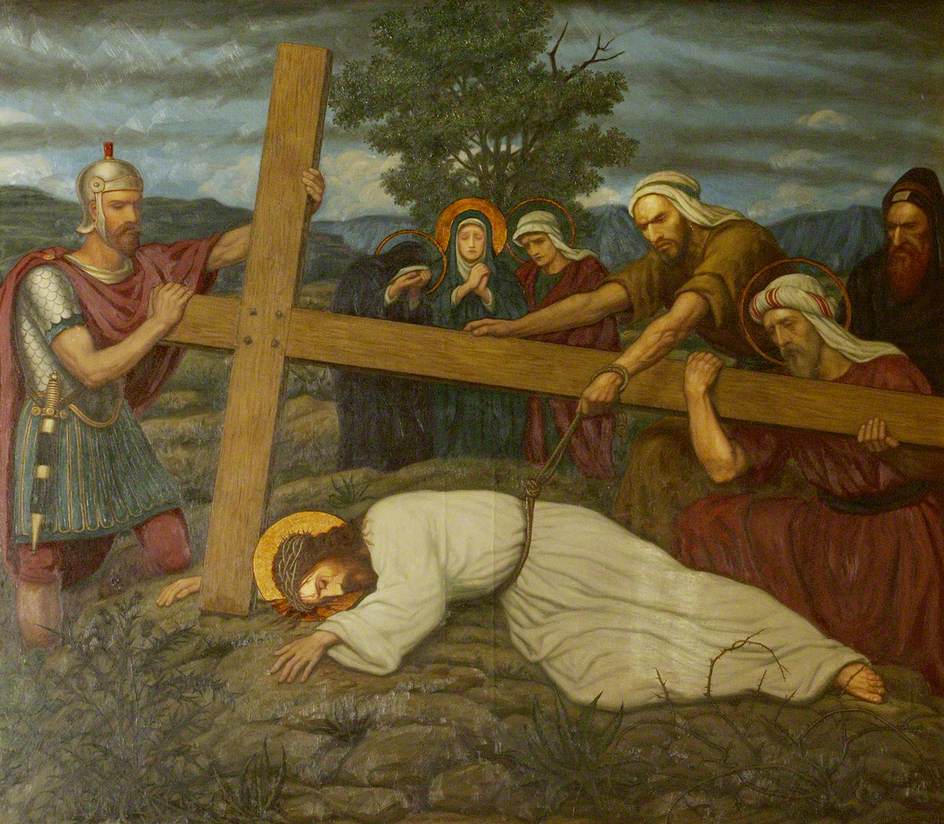
The eleventh station on the Way of the Cross is the subject of my November column in the Scottish Catholic Observer. It’s out today. Hurry down to your local parish for your copy this weekend. If you are too late don’t worry because the full text will appear here next week. It’s much better to get the paper, though, because there are other writers of interest there.
Category: My Column
Jesus is Stripped of his Garments – Full Text
The Way of the Cross 10
Jesus is Stripped of His Garments
The tenth station on the Way of the Cross concerns Jesus being stripped of his garments before he is crucified. Considering the treatment Jesus experiences on this journey, this might seem to be almost trivial in comparison. In our society people go off to Spanish beaches and strip at will. What is the significance of this station?
Obviously Jewish society in Jesus’ time would not have shared our permissive attitudes. To strip someone in public would be to shame them, to remove their dignity. I suspect most of us would feel the same despite the permissive society we live in. Clothes are very important to people. Your clothes don’t just guard your modesty; they make a statement about you.
Your clothes can say something about your status in society. Their messages can be confusing at times. We had a conversation about a dress code for Eucharistic ministers at a recent Parish Committee meeting. Is it permissible to wear jeans on the altar? I noted that my ‘respectable’ trousers from the outlet shop cost much less than the expensive jeans worn by many young (and not so young) people. Who is being more respectful?
Keeping up with fashion can be tricky and I suppose I’ve just given up on that one. Clothing can also tell about what we do. Uniforms identify nurses, firemen, the police and other groups who command our respect. We can choose our clothes to put on appearances, to create the right impression and, perhaps, disguise who we really are. Clothes don’t just fool other people about who we are. If we choose the right clothes we can feel better about ourselves. We like to pretend we are somebody special.
When the soldiers stripped Jesus they thought they were stripping him of his dignity. They took his clothes and even drew lots to see who would get his seamless garment. They thought they could win this ‘treasure’. In fact their attention was on a piece of cloth while the real treasure was being nailed to the cross. How easily our attention can be taken by the clothes and we miss the real person inside them.
In the Nazi concentration camps of the second world war the victims were stripped of their clothes and their dignity before they were gassed. The guards collected their clothes and meagre belongings as a fundraising exercise. They valued the belongings but not the human beings. My clothes can hide the real me. Perhaps they hide the real me from me as well as everyone else. Perhaps I’m not too keen on looking at the real me. What am I trying to hide? I suppose I’m not terribly impressed by the real me.
Without my clothes to create a good impression I’m just an ordinary human being with no status and no special properties. Worse than that; I’m an imperfect human being. When Adam and Eve lunched on the forbidden fruit they discovered their nakedness and were ashamed. They donned some makeshift clothes to hide themselves and hide their sinfulness. We have been doing the same ever since. We don’t want to admit that we are only sinners. We are ashamed of that.
When Jesus was stripped of his garments he showed us his humanness. He was a human being with a body just like ours and he was God. By adopting our humanity he showed us that our dignity does not come from our clothes or the worldly status the clothes proclaim. Our dignity comes from being human; from being created by God. Not only are we created by God but God sent his Son to be sacrificed for us. We are created in God’s image. What greater dignity could we hope to have?
One of the most important things I learned in my teacher training course was that we can not learn anything unless we realise that we don’t know. It’s only when we realise that we don’t know something that we can set about finding out. Similarly, it is only when we realise that we are imperfect that we can go about improving ourselves.
We tend to think of ourselves as being nice people. I had a woman at the door a year or so back with a bible tract that declared that Jesus would return to deal with the wicked people. She asked me when this would happen. She was a bit disturbed when I said that I hoped it would not be for quite a while. “Why don’t you want Jesus to come and deal with the wicked?” she asked me. I told her I needed some time to sort myself out or he would be dealing with me.
She insisted that I was wrong. Jesus was coming to deal with the wicked, not people like us. She wasn’t too pleased when I hinted that we might think we are ok but others might have another opinion and I would need some time to improve. She went away but I don’t think she understood my point. There are none of us so good that we can presume that Jesus won’t be coming to deal with us.
When we can admit to ourselves that we are sinners we can start to get things into perspective. Try as we might we do not have the power to make ourselves perfect. Only God has that power and I for one am relying on his infinite mercy for my salvation. The whole point of the crucifixion and Jesus’ suffering on the Way of the Cross was to save us; all of us. He did not come to condemn anyone. Jesus is ready to forgive our sins. He is ready to forgive all our sins, no matter how terrible we might think they are.
He will forgive the greatest sinners. Who is the worst person who has ever lived? Is it Hitler? Is it Stalin? Try to imagine the greatest sinner and now try to imagine how anyone could be so forgiving as to forgive that terrible person. Well Jesus can do that. I’m trying to imagine what it would be like to die and go to Heaven. Who would you meet there? I would imagine meeting the great saints and the martyrs. Perhaps I would come face to face with Adolph Hitler. How could that be?
If the greatest of sinners looks at themself and admits what they have done and asks for forgiveness with true contrition then Jesus will forgive them. That’s the message in Jesus being stripped of his garments. We must strip away all the trappings of status and grandeur we like to clothe ourselves in and face the real person we are. I need to acknowledge my sinful nature and admit that’s who I really am. Then I can ask God for forgiveness and by his mercy be forgiven.
I don’t really need fancy clothes to impress people. If other people can’t see beyond the cloth and recognise me as a person, then that’s their problem. After all, the God who created the universe can see who I am despite my numerous failings he sent his only son to save me.
If you ever have one of those days when you feel worthless, then just remember God sees you differently.
Joseph McGrath
Jesus is Stripped of his Garments – My October Column
My series of articles on the Way of the Cross continues this month with thoughts on the tenth station, Jesus is stripped of his garments. How significant is this event in the light of the horrors of crucifixion? Why is this included in the way of the cross?
In an age when people regularly fly off to sunny shores to strip themselves of their garments it might seem to be a strange thing to pray about. Perhaps it goes deeper than that. My column is published in this weeks Scottish Catholic Observer. Why not get down to your local parish and get a copy? You may find it interesting.
If you are too slow and the papers are all gone when you get there, don’t worry. The full text will appear here next week.
Jesus Falls the Third Time -Full Text
Way of the Cross 9
The ninth station; Jesus Falls the Third Time
In this month’s column I want to look at the third fall of Jesus. Just as with the earlier falls,I can’t find any reference to the fall in the gospels. The three falls are included for a reason. They carry a message for us and we have to figure out what it is. What is the significance of this third fall?
The number three has had a mysterious significance for people since ancient times. Mathematicians list a whole range of special features of the number three. For example, according to Pythagoras and the Pythagorean School, the number 3, which they called triad, is the noblest of all digits, as it is the only number to equal the sum of all the terms below it, and the only number whose sum with those below equals the product of them and itself. Three is regarded as a magic number.
Storytellers often used this in their tales. Think of children’s stories like the three little pigs. The story repeats with the big bad wolf attacking the pigs in turn. At the third pig’s house the wolf is defeated. This pattern is repeated in other stories, even some modern films. We might expect the third fall to be the end of the story on the way of the cross. After all Jesus is now exhausted. He has lost a lot of blood and has had a night of torture and no sleep.
When Jesus falls again he knows what awaits him. There is no place to go. Why does he get up? That is the mystery here. He could easily have lain down and died there without the humiliation of the cross. Why, then,did he get up and struggle on? Jesus knew that he had to die in humiliation. He died to conquer death and save mankind, but the manner of his death had to convey a message to those who chose to follow him.
In searching for the message I’m drawn to the image of a man suffering and on the verge of death pulling himself up and pressing on to face something even worse. That’s a message which strikes home today as we face calls to change the law to allow euthanasia. Why should someone suffer when they could die in dignity? Why should they not just give up? Jesus gives the answer to that question. His life had a purpose and he could not give it up before that purpose had been served.
Each of us enjoys the great gift of life. Our lives also serve a purpose and we must keep going till we have served that purpose. Some might ask what purpose can be served by someone dying a long, lingering death? I have not been there, yet. I do remember my great aunt who lay dying in hospital for what seemed like many months. I would drive my mother and grandmother to visit her every week. Each time she seemed to get smaller and smaller. I remember the last time I saw her before she died. She lay there, skeletal, praying her rosary for the souls in purgatory. She still had a purpose
His Holiness, Pope John Paul II also saw the need to make a point about the sanctity of life. As he aged his body deteriorated and he suffered debilitating illness. Many people both in the Church and outside thought he should retire and make way for a fitter man. He decided otherwise and carried on in his vocation.
I’m sure he would have made his decision after spending a great deal of time in prayer. He was reminding us of the message Jesus gave us in the manner of his dying. Everyone has value, the poor, the sick and the dying. John Paul may have been physically wrecked but mentally he was fit to carry on.
I believe Jesus’ message to us was to show us how we must value the gift of life and the reason we have it. That is not the only message he left us.Jesus showed us something about humiliation. Nobody wants to be humiliated. None of us want to be ridiculed in public. When Jesus allowed himself to be humiliated before the mob around the cross he was sending us a message. When people humiliate you they do it for a reason. The Jewish authorities had to humiliate Jesus in public to protect themselves. They wanted to put an end to his teaching that exposed the hollowness of their own teaching. By humiliating him they hoped discourage his followers and remove the threat to their authority.
How often do we see this today when someone can’t be overcome in a debate and their opponent makes personal attacks on them? How often are people howled down in Parliament when their opponents have no answer to their questions? The message of the ninth station is clearly that we should never be afraid of being attacked or abused for our faith. In fact we should be happy when we are abused for being a follower of Christ. The abuse is not only a conformation of the correctness of our cause but it is much more.
Suffering abuse for the faith allows us to share, in a very small way,the humiliation that Jesus suffered. It also gives us an opportunity to show others that we can face up to the abuse and not give up our faith. Recent events in the Middle East have given us the example of Christians who were faced with the choice of giving up the faith or being killed. Many fled before the Isis terrorists but some gave up their lives, some beheaded in front of their children.
We are more fortunate than those poor souls, but their sacrifice should be an example to us. Where we are expected to do much less than them, surely we should be ready to stand up and be counted for the faith.
This is the purpose that the Christian has in life. Our lives are a gift and we are asked to use that gift to work for the coming of the Kingdom of God. We may all have different roles in life but we are all expected to bear witness to the Father. We can do this every day. We can do this at home and at work. We must bear witness to everyone we encounter, every day.
We bear witness by behaving as Christ would in dealing with the joys and fears, pleasures and pains that life puts before us. We show the world a better way by our reaction to the problems of the world. How do we react to those who are suffering at the hands of Isis? What do we do about the refugees from the fighting in Syria? We can make a financial contribution but, is that it? Can we walk away safe in the knowledge that we have done our bit?
The Christian calling is not a simple matter. Trying to be like Christ is setting ourselves up to fail. We will never match him. It’s not about succeeding but about how we go about failing to match our Saviour.
My September column: The Ninth Station
The ninth Station on the Way of the Cross;- Jesus Falls the Third Time.
Why is this significant? Why did he fall only three times? Why did he get up again?
For my thoughts on this mystery get your copy of the Scottish Catholic Observer this weekend. It’s out today. My column should be there.
If you are away on business or holiday or still have your head tucked under the blankets duvet afraid to find out the result of the referendum then the full text will appear here next week. The paper is better though with so many other interesting writers. (Should I have left out ‘other’?).
The Way of the Cross -8 My August Column
Jesus meets the women of Jerusalem
In this series of articles I’m looking at the way of the Cross and I’m trying to find the meaning behind it; the message for us. This is a curious incident on that final journey. Who were these women/ Why were they weeping and why does Jesus speak to them in the way he does? It’s very strange and it needs looking into.
I looked into the gospel accounts to see what I could find there. The only mention of this comes in Luke’s gospel.
Large numbers of people followed him, and of women too, who mourned and lamented for him. But Jesus turned to them and said, ’Daughters of Jerusalem, do not weep for me; weep rather for yourselves and for your children. For the days will surely come when people will say, “Happy are those who are barren, the wombs that have never borne, the breasts that have never suckled!” Then they will begin to say to the mountains, “Fall on us!”; to the hills, “Cover us!” For if men use the green wood like this, what will happen when it is dry?’
Luke 23: 27, 31
The other three evangelists do not mention this incident. Why has Luke picked this out? He must have recognised an important message in this passage. The women in the passage are not the women who followed Jesus from Galilee. They are women of Jerusalem. If they are not followers why are they weeping and why does Jesus seem to discount their sorrow?
The question is one of ritual. Death has many rituals in different societies. In Jewish tradition women would be hired to come and weep and wail at funerals to set the sad, sombre tone of the occasion. This harks back to the story of Rachel whose tears prompted God’s forgiveness. Rituals like this are not uncommon in many societies. In Africa there are many tribes where wailing women are a matter of course.
I recall a story from my friend Father Pat McGuire who was on his first mission station in Ghana when he had to officiate at a funeral. The dead man’s widow jumped into the grave to be with her husband and could not be persuaded to come out. At a loss, Father Pat turned to a local priest for advice. He was told to start filling in the grave. When the first spade of earth was put in the woman jumped out. She was following a local ritual.
This may seem strange to us but we do similar things. Do you remember the film Oliver? Oliver was sold to an undertaker and dressed in black with a top hat, a mummer to precede the hearse and set a sad tone. We are still bound by funeral rituals today. We wear black. We have solemn faces, bells toll a solemn message of sadness. Yet, as Christians, we believe that death is the start of our new life in heaven; surely a happy occasion?
Rituals around death are changing in our society as we reject religion and need something in its place. I remember watching the funeral of Princess Diana and being amazed when people began throwing roses on to the hearse. Laying bunches of flowers, teddy bears or football tops on railings or at the roadside has become a ritual to mark the death of a loved one or even someone we barely knew. People are searching for something to replace a religious ritual. Perhaps the religious ritual really held no great meaning for them in the first place.
I am writing this while we are celebrating (?) the start of the First World War, the Great War as the media are calling it again. We have solemn ceremonies of rembrance of those who dies one hundred years ago. There seems to be little remembrance of those politicians who failed to avert a war in the first place. History shows little evidence of lessons learnt from the slaughter as we have managed to keep fighting wars where there need be none.
Is this false ritual what Jesus was referring to when he told the women not to weep for him? The ritual can hide the truth. Jesus’ words refer the women to another part of the Torah, our old testament, where in Jeremiah it says,
You there! Call the mourning women! Let them come! Send for those who are best at it! let them come! Let them lose no time in raising the lament for us! Let our eyes rain tears, our eyelids run with weeping! Yes, the wail is to be heard from Zion, what ruin is ours, what utter shame!
Jeremiah 9:16,19
This is in the face of the punishment that God is to wreak on the Israelites for forsaking the law.The passage about calling on the mountains to fall on us is a reference to another scriptural passage. This one is from Hosea 10:8 warning the Israelites of the punishment God will mete out for their unfaithfulness. Perhaps Jesus is warning the Jews of what is to befall them after rejecting him as the Messiah.
Jesus is the green wood in the quote. He brought the completion of the covenant between God and man a new covenant. The Jews rejected him and stuck with the dry wood, the incomplete covenant. This would not be immediately obvious to the people. After the crucifixion the Jewish religion continued and does to this day. Christianity started small and grew slowly.
The message in Luke’s gospel is really one for us. He is warning us about adopting rituals which, though not bad in themselves, can hide the real message. What do I mean by that? Let’s look at ritual in our Christian lives. Going to mass on a Sunday is a good place to start.
When I was a boy (not really that long ago, surely) we were taught that the obligation was to assist at the sacrifice of the mass. That is a wee bit more than just being there. At the consecration we are witnessing something extraordinary. The bread and wine becomes the second person of the Trinity. Lights don’t flash. There is no booming voice from heaven. Never the less we come into the presence of Jesus, our saviour. This is impossible for us to understand fully. It requires our belief. How do we react to this?
Reactions vary. Some people talk through this part of the mass. Some read the parish bulletin. Some kneel and appear devout but might be thinking about something else. Some are praying in the presence of the Lord. I’m not making any judgements here. I’m just admitting that the ritual sometimes does not highlight the importance of the moment but can fool us (me included) into thinking we have got it right. If we are not offering ourselves with the bread and wine, if we are not joining in the sacrifice at the consecration then we are missing the point.
The rituals are good. They are the signposts that can keep us on the right track, alert us to something important. When we forget to recognise what the ritual is alerting us to then we have lost the plot. We are like the weeping women. The Pharisees were hot on ritual and you know what Jesus thought of them.
This is not about ‘going to communion’ and then carrying on with things as normal. This is our opportunity to accept Jesus into our lives and give that life to him in our sacrifice. We should be going out of church on a mission. We should be out to change the world, starting small, growing slowly. Changing ourselves and becoming an influence on others by our example.
In this station I have learned something Luke wanted to tell us about ritual. We must be able to recognise Jesus there and be alert to his presence in our lives.
Joseph McGrath
My August Column – Jesus Meets the Women of Jerusalem
My August column is published today in the Scottish Catholic Observer.
The eighth station – Jesus meets the women of Jerusalem. Who were these women and what were they really weeping about? Why do they get a mention today after almost two thousand years?
Is there a message here for any of us? Get the paper this weekend and see for yourself.
Don’t worry if you miss it. The full text will be available here next Friday (5th September). There is a lot more in the paper though.
Joseph
The Seventh Station – Jesus Falls the Second Time
Jesus Falls the Second Time
This month I’m looking into the seventh station on the Way of the Cross. Jesus falls for the second time. The second fall should not be unexpected. Jesus was getting weaker with loss of blood. Yet a second fall brings with it the warning that this will continue. I wrote earlier about tripping on a kerbstone in Paris and the shock of the fall. The problem is when tripping becomes normal.
Last year I found myself suffering with sciatica. I thought it would go away by itself but it got worse. What can you do? I went to the doctor and he sent me for physiotherapy. I thought that was helping but found I was stumbling when I walk. It now appears I have a worn hip so I just keep taking the tablets. When I walk I sometimes find my foot doesn’t go where I meant it to go. Tripping and the consequent fall has become a feature of life now.
Jesus’ second fall is a metaphor for sin. Just like my occasional fall, falling into sin becomes a feature of life. We can think of a fall from grace or a fall into sin. Falling into sin makes sin sound like a trap and so it is. I don’t know about you but I can excuse myself by thinking that a sin is not serious or is not harming anyone. That’s the trap. Just like my problem with tripping falling into sin is a normal part of life. We need to be aware and ready for the unexpected.
Now, in sin, I’ve changed my perspective. I’m seeing things slightly differently. When my perspective is distorted my decisions get distorted too. I’ll give you an example. I’m six foot two and I can reach for things on high shelves but often get into bother because if you measure me I’m only five foot eight. I have a similar problem with cameras that don’t capture my full head of hair. I think you get the picture.
If my view of reality is distorted then my relationship with others will be too. My sin distorts my view of the world unless I realise that I am wrong and do something about it. To return to the analogy of the fall, you can’t get up unless you know you are down.
This was brought home to me recently when I read on Twitter about a woman in America who threw her children out of the window. That was disturbing, shocking. What was more disturbing were the comments added by other readers. They posted all sorts of suggestions about the sorts of torture that the woman should suffer.
The comments were based on the view that this woman is evil. Nobody suggested that she might be suffering from some psychological disorder and be in urgent need of help. Was this based upon the perception that we are good and guiltless and the woman must be evil? If so then we are in the trap of sin. None of us are without sin. Once we realise that we can look with compassion on others.
Another example I found in the news was the funeral of Fr. Kenneth Walker who was murdered trying to defend his fellow priest in Phoenix, Arizona. A group of protesters from Westboro Baptist church demonstrated with placards at the church. They are an unaffiliated church and have been demonstrating at the funerals of service personnel who died in Afghanistan. They claim that these things are God’s punishment.
I suppose that’s an old idea of God. It’s a picture of a vengeful God who is watching out for us to fall into sin and take revenge on us. Nothing could be further from the truth. Jesus came to save us, not condemn us. The sufferings and falls we contemplate in the Way of The Cross are how Jesus took the punishment for our sins. God is always ready to forgive. We just need to turn back to Him.
How often have you heard people talk about Catholic guilt? The story goes that we are brought up in an atmosphere of sin and guilt. This causes all sorts of psychological problems that are only solved when you give up religion. Of course it’s all nonsense. Being aware of sin and the effects of sin on our lives gives us the opportunity to change and improve life. As Catholics we have the sacraments to help us be reconciled with Jesus and rid ourselves of any burden we feel.
If we are forgiven, free of sin, then we are in a position to treat others in the same way. We should be able to “forgive those who trespass against us”. How much evil in the world is committed because of perceived wrongs others have done to us? There are wars in Africa and the Middle East caused by real and imagined wrongs. How much better the world could be if we were more ready to forgive.
We can look to South Africa for a great example of this. The black people in that country had faced oppression under the Apartheid regime for decades. Families had suffered great injustice and brutality. When the regime fell there could have been terrible bloodletting as people took revenge. Instead there was a system of Truth and Reconciliation. People could own up to what they had done and were forgiven. The bloodbath was avoided.
So how do we get out of the trap? It’s not easy. You know the story about the man who took a shortcut on his way home from the pub. He cut through the cemetery and fell into a grave dug for a funeral next morning. Try as he might he could not get out so he sat down to wait for morning. Soon another reveller fell into the same grave and tried to climb out. The first man tapped him on the shoulder and said “You’ll never get out.”. But he did with one jump.
Who can give us the tap on the shoulder? Who can help us out of the trap? Obviously Jesus is the one to turn to. In Jesus we can find the compassion we need to help us. We can find him in the sacrament of reconciliation. Some of us find that very difficult. We can’t shrug off the feeling of guilt and can’t bring ourselves to take that step into the confessional. In this second fall we see Jesus, in his agony, get up and take an even more difficult step. He encourages us to do the same.
I had a friend who had been away from the Church for years. After attending the funerals of two lifelong friends in succession he decided it was time to set things to rights. He told me he went to confession, ready for a hard time from the priest. He was surprised to find that rather than a hard time he was welcomed back and his sins forgiven. There was a visible change in him. He was a happier man in his dealings with everyone.
When we see Jesus get up from his second fall in the seventh station we should be reminded that no fall is too great for his compassion. No matter how far we fall or think we have fallen Jesus is there to help us up again. So let’s forget about guilt and concentrate on forgiveness. Jesus is ready to forgive us and we must be ready to forgive one another.
Joseph McGrath
When Falling Becomes a Habit
My monthly column should be bublished early this month. I’m told it will be in this weeks issue of The Scottish Catholic Observer. It deals with the seventh Station on The Way of The Cross, Jesus falls the second time. Is this about falling over? What could it really be about? Does it have any meaning for you and me?
Get your copy of the paper this weekend. If you are off to Turkey or some other exotic place you can get the full text here next week.
Joseph
The Sixth Station: Veronica Wipes the Face of Jesus
The Sixth Station
Veronica Wipes The Face of Jesus
This month I’m looking at the sixth station, Veronica wipes the face of Jesus. This is a really puzzling station. In our story of Jesus men seem to get the main parts. Peter gets to be the head of the Church. John gets called the beloved. You can understand how people see the Church as a man’s world with women in the back ground. I’ll not get into the discussion on woman’s place in the Church, not today anyway.
This station gives us pause for thought if we think women have no prominence in our story. We have been considering the final journey of Jesus as he walked to his death. The scene is one of brutality, oppression and fear. Where are Jesus’ faithful companions? One of them has betrayed him and the others have run off. Jesus is struggling under the weight of the cross, his loss of blood so weakening him that Simon has been pressganged in to assist him. The crowd is shouting abuse and the guards are pushing them back. Into the middle of this Veronica forces her way through the crowd, ignores the guards and places a towel on the holy face. The face is streaked with blood from the wounds on his head. Veronica absorbs the blood on the towel to give a little comfort to Jesus. As she is pushed away she is left with the imprint of the holy face in blood.
I have no scriptural evidence for this but it is traditional. It is interesting to note that the name Veronica comes from the Greek icon meaning image and the Latin vero meaning true; the true image. The tradition seems to have come from the Eastern Church and became popular in the Roman rite about a thousand years ago. I’m more concerned about the message this story has for me than the history.
The first thing that strikes me is the courage displayed by Veronica. Many Jews had become followers of Jesus, some of them prominent like Nicodemus. Yet even prominent men were afraid to come forward to intercede. It was this lone woman who broke through the crowd and ignored the soldiers to bring some small relief to Jesus. The amazing thing is that she got away with it. Why did she act in this way?
I have no doubt that she was inspired by the Holy Spirit. There lies the first message. When the Holy Spirit moves you, you have nothing to fear. You will succeed. Now I had always imagined that the Holy Spirit would act through the Apostles, their successors in the Church and the saints. Veronica was just a wee wummin as they might say in Glasgow. She was not one of the elite; a bit like you and me. The message is clear. Be prepared to act as an instrument of the Holy Spirit. As ordinary people we can and will be called upon to act.
It may not be in a dramatic way like Veronica but in a small way. It might be to give that kind word to a stranger that gives them encouragement to carry on in a difficult situation or you might be moved to speak out against an injustice. The words just come to you. I remember Magnus MacFarlane Barrow describing how he came to found Mary’s Meals. He was just an ordinary young man, too shy to continue his university course who found himself starting a charity. He didn’t recognise what was happening at first but when he did he followed the Spirit. You know the rest.
The second message I get from this station is about the role of women in the Church. Not just women but all of us ordinary people. Critics of the Church often point out that we are a church of men and women are only good for making the tea. I think that is to fail to see how the Church works. It is true that our priests are men and the hierarchy is exclusively male. However, the vast bulk of the Church is not comprised of clergy and religious.
The Spirit acts through all of us. I think of the hierarchy as the management, the priests as specialists who alone can bring us to Christ through the Eucharist and the rest of us as the workforce whose job it is to get on with the work. The Church is not a club we join, pay our dues and draw the benefits. The Church is a way of life, new life in Christ.
Now I can hear the voice of reason tut tutting in the background. That’s all very well but we have lives to lead, families to look after, work to go to. We live in this society and we must fit in. We go to mass; we say our prayers. What more do you want?
I’ll let Veronica answer that. I’m sure she prayed and fulfilled all the requirements of the Jewish faith. Veronica did not stop there and she certainly did not fit in. She didn’t just stand out from the crowd; she elbowed her way through it. Do I stand out from the crowd or do I just try to blend in so that nobody will notice me? Veronica has shown us a great example. What she did was just a simple thing, mopping the face of a man in pain. The thing is, she did it publicly, her actions in stark contrast to the baying of the crowd. We don’t need to fight the world, we just need to be seen to live as Christ taught us and be a living example for those who don’t share our values. It takes a little courage to stand out. Where could I find the strength to live like that? I’ll have to double my prayers to the Holy Spirit.
The last message I see in this station is about the image that was left on the cloth Veronica used. At school I learned that Jesus left this image of his face as a reward for Veronica’s kindness. As Christians we are all seeking the face of Jesus. There are all sorts of pictures made by great artists but none of them is the real face. It’s not uncommon for great leaders to have their face shown to everyone. Kings, queens and presidents all have their image in the newspapers and on television.
Jesus is not going to appear on the box one night as we sit down to watch the news. If we want to see his face we must seek it out. I feel I need to take a leaf out of her book. I should be living my life as a true follower of Christ. If Christ’s teaching is at odds with the norms of my society then my life should reflect his teaching and be seen to do so. Do I meet the beggar is the same way Christ did? Do I speak out against falsehood and wrongdoing?
Perhaps if I try to live more like Christ and see people as he did, not just strangers but fellow children of God, loved by God just as much as I am, then I might just reach my goal and see God, face to face as it were. I’m fairly sure that if I continue to ignore my responsibilities to my neighbour then I might end up seeing a face I’d rather avoid.