My January Column – Where did it go?

It looks like my January column in the Scottish Catholic Observer is not in this week’s edition. That’s not a problem – I think it will be in next week. This week, however, we have a large spread on the work of The Scottish International Aid Fund (SCIAF).

SCIAF was born in my home parish of Saint Columbkille’s in Rutherglen and has made unbelievable changes to the lives of some of the poorest in the world. You really need to see this weeks paper to get a flavour of what they are doing.

Try again next week for my article.

Jesus is Nailed to the Cross – Full Text

A crucifix

The large crucifix in Nigeria

The 11th Station Jesus is nailed to the cross


In this series of articles I’m taking the Way of the Cross and pondering on what each station is saying to us. I must stress that these are personal thoughts and if they seem a bit strange then that’s about me rather than the Church. The eleventh station recalls that Jesus was nailed to the cross. We are all familiar with this.

I grew up in a house with a crucifix on the wall. My rosaries have a small crucifix on the end. Jesus nailed to a cross has been the wallpaper of my life. Every church I visit has at least one crucifix. Some are small and some are large they are all works of art. I expect to see a crucifix on a church, a classroom wall, in a home. It is just a familiar item.

A few years ago I read an article by a woman who had gone into a church and was shocked by the sight of a man nailed to a cross – a crucifix. What sort of people are these who have horrible things like that in their churches? I was shocked at her reaction. Had she never seen a crucifix? Where was she coming from?

In my Missio life I was on a visit to Nigeria and stayed for a few days in a parish in Lafia. I wandered into the church where the ladies were preparing for the harvest festival mass. The crucifix on the wall behind the altar (see the picture) was the biggest I have ever seen. It dwarfed everything and everyone. I literally fell on my knees. Now it was my turn to be shocked. I’m not sure why, perhaps it was the sheer size of the crucifix, but the thought in my head was, “What have I done?”

Now I’m sure you learned the same thing as I did at school; Jesus died on the cross for my sins. That is disturbing but this giant crucifix brought home to me the enormity of what happened. No other crucifix I have seen has had this effect on me. How do I deal with this? As usual I’ve pushed it to the back of my mind to pretend it is not there; but it is there and will not go away.

Peter Howson is an artist I have admired for some time. He paints picture that do not flatter but point the finger. He completed his “Saint John Ogilvie” for the refurbished cathedral on Clyde street and there was an exhibition of some of his preparatory sketches and paintings in the adjacent offices. I went along, eager to see how he had come to his final work.

The whole exhibition was very moving. One sketch in particular caught me. It was the face of Christ, crowned with thorns and terrified! This was not the quiet suffering face of Christ I had seen in many works of art. This was the face of a man about to go through an extremely brutal experience. He was about to be nailed to the cross. This image made me stop in my tracks. It was the first picture I have seen that conveyed the true horror of what Jesus underwent; and he did it for me.

Suffering is not something we are unaware of. If you are clumsy like me then you you suffer lots of minor accidents. Have you ever hit your finger with a hammer? I’m not trying to promote this as a hobby. It is very painful and produces all sorts of words your children should never hear. I have done this many times; take it from me, it is not to be recommended. It is even worse to puncture yourself. Getting a cut in the kitchen or even pricking yourself with a needle cause pain but it passes and soon heals.

Have you ever stapled your finger? That’s altogether different. It hurts on the way in and it is really painful on the way out. That’s because, unlike the needle or the kitchen knife, the edge of the staple is ragged. When they nailed Jesus to the cross they didn’t have the smooth, regular, machine made nails we are familiar with. In those days nails were made by hand by a blacksmith wielding a hammer. The nails were bashed out of bars of iron. There was nothing delicate about these rough-hewn pegs.

Jesus was held down and the nails were bashed through him into the wood. Most of the old paintings show the nails piercing his hands but more recent commentators have decided that it is more likely that the nails pierced his wrists. I don’t know if it makes a difference which one it was. In both cases the nails must have shattered bone and muscle. It is really too horrible to contemplate.

A few years ago, in 2004 to be exact, Mel Gibson directed a film called ‘The Passion of the Christ’. It re-enacted the last twelve hours of Jesus’ life. The Passion of the Christ is the highest grossing R-rated film in United States history, and the highest grossing non-English-language film of all time. It caused outrage. Some critics called it obscene. It was shown on television a few years ago and I decided to watch. I gave up watching at the scourging at the pillar. It was obscenr because it was depicting that was too horrible to watch.

Some complained that it was blaming the Jews for killing Jesus. Some complained that the extreme violence obscured the message. I don’t agree with either complaint. The film made me feel that I have caused this horror because Jesus died for my sins. The violence is part of the message. We find it difficult to deal with the violence because it reflects on us.

This year and especially during the month of November we have been looking back to the First World War. Our televisions have shown us the slaughter that both sides inflicted on each other. We have paid tribute to those who died for their country. We have solemn parades and use the poppy as a symbol of the blood let on Flanders fields. Yet we fail to look at the real horror. This was a war where new weapons were devised to kill more man more quickly.

Soldiers were killed by poison gas; flamethrowers were introduced to exterminate whole trenches of men. Machine guns provided mechanised killing. Aircraft were used to bomb civilians for the first time and battleships shelled towns on the east coast. Things only got worse from then on. Today we have weapons that can exterminate continents. We use advances in technology to bring the horrors of war to any place on the world, to any people and we can do it without leaving the office.

What is the significance of Jesus being nailed to the cross? Is Jesus showing us how we use cruelty and violence to get our own way? It was a warning to us. He showed us that it is in our human nature to be cruel. Despite the gifts of intelligence and science we have been given we can usually find a way to misuse them.

Why do I prefer the small crucifix on my rosaries to the large on that church wall in Nigeria? Well I suppose I find it hard to face up to the fact that it was my fault.


Joseph McGrath

My November Column Jesus in Nailed to the Cross

Jesus is Nailed to the cross

The eleventh station on the Way of the Cross is the subject of my November column in the Scottish Catholic Observer. It’s out today. Hurry down to your local parish for your copy this weekend. If you are too late don’t worry because the full text will appear here next week. It’s much better to get the paper, though, because there are other writers of interest there.

Jesus is Stripped of his Garments – Full Text

The Way of the Cross 10

Jesus is Stripped of His Garments

Jesus on Calvary

Jesus is Stripped of His Garments

The tenth station on the Way of the Cross concerns Jesus being stripped of his garments before he is crucified. Considering the treatment Jesus experiences on this journey, this might seem to be almost trivial in comparison. In our society people go off to Spanish beaches and strip at will. What is the significance of this station?

Obviously Jewish society in Jesus’ time would not have shared our permissive attitudes. To strip someone in public would be to shame them, to remove their dignity. I suspect most of us would feel the same despite the permissive society we live in. Clothes are very important to people. Your clothes don’t just guard your modesty; they make a statement about you.

Your clothes can say something about your status in society. Their messages can be confusing at times. We had a conversation about a dress code for Eucharistic ministers at a recent Parish Committee meeting. Is it permissible to wear jeans on the altar? I noted that my ‘respectable’ trousers from the outlet shop cost much less than the expensive jeans worn by many young (and not so young) people. Who is being more respectful?

Keeping up with fashion can be tricky and I suppose I’ve just given up on that one. Clothing can also tell about what we do. Uniforms identify nurses, firemen, the police and other groups who command our respect. We can choose our clothes to put on appearances, to create the right impression and, perhaps, disguise who we really are. Clothes don’t just fool other people about who we are. If we choose the right clothes we can feel better about ourselves. We like to pretend we are somebody special.

When the soldiers stripped Jesus they thought they were stripping him of his dignity. They took his clothes and even drew lots to see who would get his seamless garment. They thought they could win this ‘treasure’. In fact their attention was on a piece of cloth while the real treasure was being nailed to the cross. How easily our attention can be taken by the clothes and we miss the real person inside them.

In the Nazi concentration camps of the second world war the victims were stripped of their clothes and their dignity before they were gassed. The guards collected their clothes and meagre belongings as a fundraising exercise. They valued the belongings but not the human beings. My clothes can hide the real me. Perhaps they hide the real me from me as well as everyone else. Perhaps I’m not too keen on looking at the real me. What am I trying to hide? I suppose I’m not terribly impressed by the real me.

Without my clothes to create a good impression I’m just an ordinary human being with no status and no special properties. Worse than that; I’m an imperfect human being. When Adam and Eve lunched on the forbidden fruit they discovered their nakedness and were ashamed. They donned some makeshift clothes to hide themselves and hide their sinfulness. We have been doing the same ever since. We don’t want to admit that we are only sinners. We are ashamed of that.

When Jesus was stripped of his garments he showed us his humanness. He was a human being with a body just like ours and he was God. By adopting our humanity he showed us that our dignity does not come from our clothes or the worldly status the clothes proclaim. Our dignity comes from being human; from being created by God. Not only are we created by God but God sent his Son to be sacrificed for us. We are created in God’s image. What greater dignity could we hope to have?

One of the most important things I learned in my teacher training course was that we can not learn anything unless we realise that we don’t know. It’s only when we realise that we don’t know something that we can set about finding out. Similarly, it is only when we realise that we are imperfect that we can go about improving ourselves.

We tend to think of ourselves as being nice people. I had a woman at the door a year or so back with a bible tract that declared that Jesus would return to deal with the wicked people. She asked me when this would happen. She was a bit disturbed when I said that I hoped it would not be for quite a while. “Why don’t you want Jesus to come and deal with the wicked?” she asked me. I told her I needed some time to sort myself out or he would be dealing with me.

She insisted that I was wrong. Jesus was coming to deal with the wicked, not people like us. She wasn’t too pleased when I hinted that we might think we are ok but others might have another opinion and I would need some time to improve. She went away but I don’t think she understood my point. There are none of us so good that we can presume that Jesus won’t be coming to deal with us.

When we can admit to ourselves that we are sinners we can start to get things into perspective. Try as we might we do not have the power to make ourselves perfect. Only God has that power and I for one am relying on his infinite mercy for my salvation. The whole point of the crucifixion and Jesus’ suffering on the Way of the Cross was to save us; all of us. He did not come to condemn anyone. Jesus is ready to forgive our sins. He is ready to forgive all our sins, no matter how terrible we might think they are.

He will forgive the greatest sinners. Who is the worst person who has ever lived? Is it Hitler? Is it Stalin? Try to imagine the greatest sinner and now try to imagine how anyone could be so forgiving as to forgive that terrible person. Well Jesus can do that. I’m trying to imagine what it would be like to die and go to Heaven. Who would you meet there? I would imagine meeting the great saints and the martyrs. Perhaps I would come face to face with Adolph Hitler. How could that be?

If the greatest of sinners looks at themself and admits what they have done and asks for forgiveness with true contrition then Jesus will forgive them. That’s the message in Jesus being stripped of his garments. We must strip away all the trappings of status and grandeur we like to clothe ourselves in and face the real person we are. I need to acknowledge my sinful nature and admit that’s who I really am. Then I can ask God for forgiveness and by his mercy be forgiven.

I don’t really need fancy clothes to impress people. If other people can’t see beyond the cloth and recognise me as a person, then that’s their problem. After all, the God who created the universe can see who I am despite my numerous failings he sent his only son to save me.

If you ever have one of those days when you feel worthless, then just remember God sees you differently.

Joseph McGrath

Jesus is Stripped of his Garments – My October Column

My series of articles on the Way of the Cross continues this month with thoughts on the tenth station, Jesus is stripped of his garments. How significant is this event in the light of the horrors of crucifixion? Why is this included in the way of the cross?

In an age when people regularly fly off to sunny shores to strip themselves of their garments it might seem to be a strange thing to pray about. Perhaps it goes deeper than that. My column is published in this weeks Scottish Catholic Observer. Why not get down to your local parish and get a copy? You may find it interesting.

If you are too slow and the papers are all gone when you get there, don’t worry. The full text will appear here next week.

Jesus Falls the Third Time -Full Text

Way of the Cross 9

The Third Fall

The Third Fall

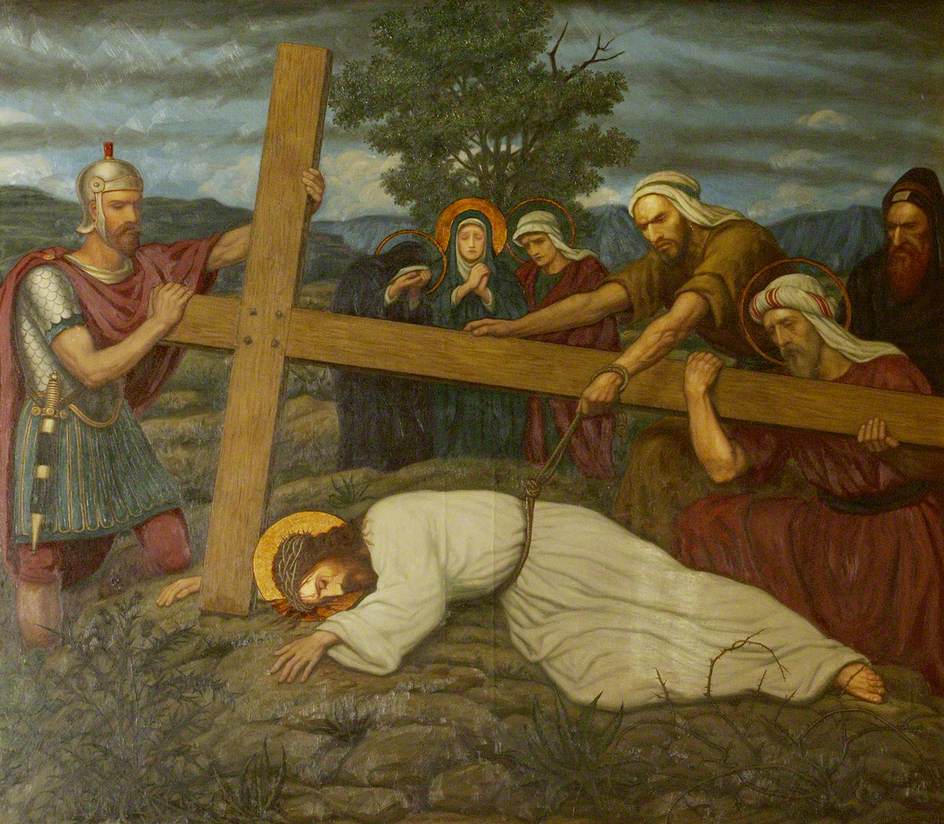
The ninth station; Jesus Falls the Third Time

In this month’s column I want to look at the third fall of Jesus. Just as with the earlier falls,I can’t find any reference to the fall in the gospels. The three falls are included for a reason. They carry a message for us and we have to figure out what it is. What is the significance of this third fall?

The number three has had a mysterious significance for people since ancient times. Mathematicians list a whole range of special features of the number three. For example, according to Pythagoras and the Pythagorean School, the number 3, which they called triad, is the noblest of all digits, as it is the only number to equal the sum of all the terms below it, and the only number whose sum with those below equals the product of them and itself. Three is regarded as a magic number.

Storytellers often used this in their tales. Think of children’s stories like the three little pigs. The story repeats with the big bad wolf attacking the pigs in turn. At the third pig’s house the wolf is defeated. This pattern is repeated in other stories, even some modern films. We might expect the third fall to be the end of the story on the way of the cross. After all Jesus is now exhausted. He has lost a lot of blood and has had a night of torture and no sleep.

When Jesus falls again he knows what awaits him. There is no place to go. Why does he get up? That is the mystery here. He could easily have lain down and died there without the humiliation of the cross. Why, then,did he get up and struggle on? Jesus knew that he had to die in humiliation. He died to conquer death and save mankind, but the manner of his death had to convey a message to those who chose to follow him.

In searching for the message I’m drawn to the image of a man suffering and on the verge of death pulling himself up and pressing on to face something even worse. That’s a message which strikes home today as we face calls to change the law to allow euthanasia. Why should someone suffer when they could die in dignity? Why should they not just give up? Jesus gives the answer to that question. His life had a purpose and he could not give it up before that purpose had been served.

Each of us enjoys the great gift of life. Our lives also serve a purpose and we must keep going till we have served that purpose. Some might ask what purpose can be served by someone dying a long, lingering death? I have not been there, yet. I do remember my great aunt who lay dying in hospital for what seemed like many months. I would drive my mother and grandmother to visit her every week. Each time she seemed to get smaller and smaller. I remember the last time I saw her before she died. She lay there, skeletal, praying her rosary for the souls in purgatory. She still had a purpose

His Holiness, Pope John Paul II also saw the need to make a point about the sanctity of life. As he aged his body deteriorated and he suffered debilitating illness. Many people both in the Church and outside thought he should retire and make way for a fitter man. He decided otherwise and carried on in his vocation.

I’m sure he would have made his decision after spending a great deal of time in prayer. He was reminding us of the message Jesus gave us in the manner of his dying. Everyone has value, the poor, the sick and the dying. John Paul may have been physically wrecked but mentally he was fit to carry on.

I believe Jesus’ message to us was to show us how we must value the gift of life and the reason we have it. That is not the only message he left us.Jesus showed us something about humiliation. Nobody wants to be humiliated. None of us want to be ridiculed in public. When Jesus allowed himself to be humiliated before the mob around the cross he was sending us a message. When people humiliate you they do it for a reason. The Jewish authorities had to humiliate Jesus in public to protect themselves. They wanted to put an end to his teaching that exposed the hollowness of their own teaching. By humiliating him they hoped discourage his followers and remove the threat to their authority.

How often do we see this today when someone can’t be overcome in a debate and their opponent makes personal attacks on them? How often are people howled down in Parliament when their opponents have no answer to their questions? The message of the ninth station is clearly that we should never be afraid of being attacked or abused for our faith. In fact we should be happy when we are abused for being a follower of Christ. The abuse is not only a conformation of the correctness of our cause but it is much more.

Suffering abuse for the faith allows us to share, in a very small way,the humiliation that Jesus suffered. It also gives us an opportunity to show others that we can face up to the abuse and not give up our faith. Recent events in the Middle East have given us the example of Christians who were faced with the choice of giving up the faith or being killed. Many fled before the Isis terrorists but some gave up their lives, some beheaded in front of their children.

We are more fortunate than those poor souls, but their sacrifice should be an example to us. Where we are expected to do much less than them, surely we should be ready to stand up and be counted for the faith.

This is the purpose that the Christian has in life. Our lives are a gift and we are asked to use that gift to work for the coming of the Kingdom of God. We may all have different roles in life but we are all expected to bear witness to the Father. We can do this every day. We can do this at home and at work. We must bear witness to everyone we encounter, every day.

We bear witness by behaving as Christ would in dealing with the joys and fears, pleasures and pains that life puts before us. We show the world a better way by our reaction to the problems of the world. How do we react to those who are suffering at the hands of Isis? What do we do about the refugees from the fighting in Syria? We can make a financial contribution but, is that it? Can we walk away safe in the knowledge that we have done our bit?

The Christian calling is not a simple matter. Trying to be like Christ is setting ourselves up to fail. We will never match him. It’s not about succeeding but about how we go about failing to match our Saviour.

My March Column – Full Text

The Third Station

Jesus falls under the weight of his cross

The Third Station: Jesus Falls The First Time

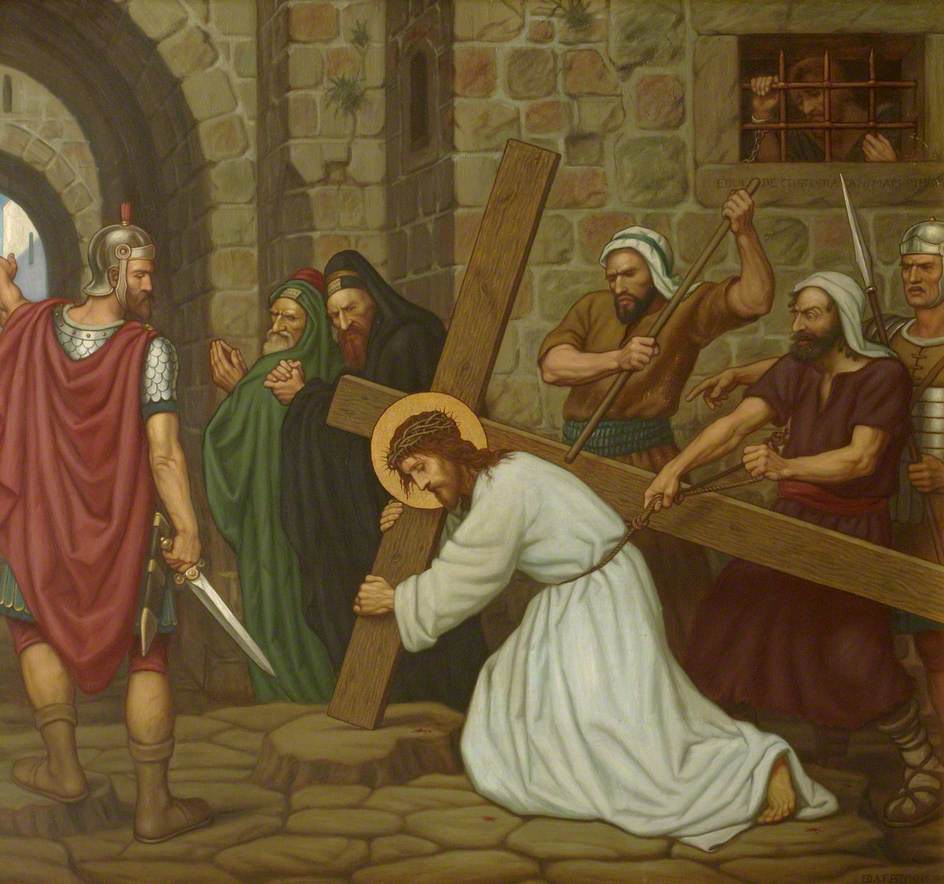
In this station we recall the first of three falls Jesus experiences on his journey. I looked through the Gospels but there is no mention of Jesus falling by any of the evangelists. Why do we think of Jesus falling and why three times?

I suppose it is reasonable to think that Jesus, in his weakened state, must have stumbled on the way through the city. The early pilgrims who followed the path that Jesus was led along must have realised from the rough nature of the paving that Jesus would have fallen and the falls have become incorporated into the way.

There must be more to it than that. There must be a message there somewhere. Three is a peculiar number. It was thought to have special powers by early people. It is the first triangular number and is used in folklore and early stories that have become fairy tales. There are three little pigs; the wicked witch tried to kill Snowwhite three times; there were three blind mice; the list goes on.

I tried to imagine a fall. What is it like to fall? I don’t need to imagine, I have fallen, an unpleasant experience. My wife and I were in Paris for a short break a few years ago. Our coach stopped to allow us to view the Eifel Tower. I had my good camera and ran across the road to get a good spot for a picture. In my haste I didn’t notice that the kerbstones were not all at the same height and I tripped. In trying to save my camera I landed heavily on the paved surface.

I was bleeding and shocked. A fall leaves its mark. The consequences of Adam’s fall left us in the perilous state we are born into, needing salvation, needing a Saviour. The link between ‘fall’ and ‘sin’ was brought home to me recently on Ash Wednesday. The Priest said, “Turn away from sin and be faithful to the Gospel”. He dobbed my forehead with ashes. This is a very positive message. In the past the message was “Remember man that thou art dust and into dust you shall return.” followed by a dusty looking mark on the forehead. The faint dusty mark was a good reminder of the dust I would return to.

When I got home I went to wash my hands and was shocked to see a big black mark on my forehead. This was no pale reminder of the dust I will return to. I was marked, marked as a sinner. Friends remarked that the priest had “really got you!” It stood out and reminded me that I really am a sinner. It was a bigger shock than the fall in Paris.

I realised that this was what the third station is about. We are sinners. If we are going along to the stations of the Cross, seeing ourselves as the good folk, not like those others who don’t appear, than here we are reminded that we are not as good as we like to think. We are the sinners Jesus came to save. We are all in this together, to use a contemporary phrase; we are here as a result of Adam’s fall. It is in our nature to sin. We were created with free will and we can choose to do good or evil. All too often we do not choose good.

This first fall reminds us that Jesus was fully man and experienced all the difficulties we are open to. He understands that we sometimes find ourselves in circumstances where we are prone to fall, to fall into sin. Jesus’ capacity for understanding sinners is the truly amazing feature of his life on earth. His sympathy for sinners shocked the right minded people of the day. The fact that he spent time with sinners and even dined with them seemed to mark him out as a sinner too. When Jesus forgave sins that really marked him out as a dodgy character.

At the first fall Jesus gets up again and carries on. He must have damaged himself, falling onto a rough path with the heavy cross on his back. His struggle is now harder, more painful. We too can get up again and carry on. We have the great gift of Jesus’ forgiveness in the sacrament of reconciliation to help us back on the road. What is there to stop us?

Well, in my case, probably pride, shame, embarrassment or some combination thereof. How can I go to confession and come away without that feeling that a great burden has been lifted from my shoulders? I’ve given a lot of thought to that question. The best answer I can find is that we don’t often encounter complete forgiveness in our human contacts. It’s out with our normal experience. My mistake is to forget that Jesus is not simply another human. He is also God.

All too often, I think, we try to make God like one of us. We should really try it the other way round. I should be trying to be like Jesus and see things the way Jesus sees them. When was the last time I looked down on someone? Who do I see when I look at other people?

I remember an account of a school visit by my Irish colleague when I was with Missio. She had a visiting nun from Uganda, Sister Fortunata. Fortunata was a big, unstoppable woman. My colleague Jackie took Fortunata to a local, Dublin primary school to give them an idea of how the missions worked in Uganda.

Fortunata asked the children if they had ever met Jesus. They answered that, of course, they had not. Fortunata told them to turn to the person next to them and say “Hello Jesus”. She impressed on them the fact that we meet Jesus in every person we meet. This was a great teaching point but Fortunata, by her nature, had to take things further. Everybody had to be addressed as Jesus.

All that day the school was filled with “Hello Jesus”, “Jesus, I like your new haircut”, “Jesus you are looking well today”.  The school remained in that uproar ‘till long after Fortunata had gone. I heard the head teacher nearly had a breakdown.

At the time I thought Fortunata was crackers. In fact she was dead right. How often do I remember that I meet Jesus in other people, in every other person? In this station we see Jesus as a broken and bleeding man in torn clothes being taken to die a shameful death. Would I have recognised him? Do I recognise him in the unfortunates that I see every day?

I have failed in this so far, but I have also learned that my failure is only a fall and I can get up again, even though that might be difficult, and start on the road again. This time I will try to remember that the people I meet are just people like me and if I look closely enough, look beyond the clothes and the wear and tear that life has brought on them, I might be able to see the face of Jesus.


Joseph McGrath


My February Column Published Today

Jesus carries his cross to Calvary

Jesus Carries His Cross

My latest column is published today in the Scottish Catholic Observer. The Way of The Cross. This month I look at the Second Station – Jesus caries his cross. What more is there to say about that? Get your copy this weekend in your local parish and find out.

Full text here next week for those who miss the rush and can’t get a copy.

The Way of the Cross 1

Strangers to Christianity often wonder at the symbolism we use. The cross is a reminder of Christ’s violent and ignominious death, a failure in human terms. Similarly, the way of the cross must seem strange to them. We follow the last steps of Jesus as He carries His cross to the place of execution. Why would we wish to remember that?

Of course, as Christians, we understand the significance of this event and we are charged to take up our cross and follow. The Stations of the Cross which we are familiar with originated in the Via Dolorosa followed by pilgrims to Jerusalem. They retraced the path Jesus followed to His crucifixion.

Today we are following a tradition which is reputed to have started with Saint Francis of Assisi who made this a devotion in churches. We don’t need to go to Jerusalem to retrace Our Lord’s last steps we can do it in our own parish. It is so much an accepted part of Catholic life that I have never given much thought to its origins or deeper meanings.

This time last year I was making my preparations for my attempt at the Camino, a testing pilgrimage. When I set off eventually I passed through Lourdes and had a passing thought about starting from there. The train moved off and the thought went. At the end of last year I returned to Lourdes for the feast of the Immaculate Conception, a less strenuous pilgrimage.

On that feast day we had Mass in the grotto followed by The Stations in the underground basilica. We were led by Father John Ahern and his commentary had a lasting effect on me. The basilica was dark and cold on that December morning. Perhaps the strange surroundings led me to think again about the Stations as a pilgrimage.

That’s where I’m going this year. I’m going to take each station in turn and see what I find. I hope you can come along.

The First Station – Jesus is condemned to death

I start by looking at what we are told in the Gospels. All four evangelists agree that Jesus was condemned to death by Pontius Pilate. They go to some length to show that Pilate was reluctant to do this. He said he could find no case against Jesus that merited death. The crowd applied pressure. They howled him down. They applied political threats. They claimed that Jesus’ claim to be a king was a threat to Caesar, Pilate’s boss.

Pilate reluctantly gave in and condemned Jesus to death. In Matthew’s gospel we learn that he washes his hands of Jesus’ blood. Matthew goes further to tell us that the people say “Let his blood be on us and our children.”

So who is guilty of Jesus’ death? The debate resurfaces from time to time. In recent years the Mel Gibson film “The Passion of The Christ” caused furore and accusations of anti-Semitism. Were the Jews to blame or was it the Romans? It is an interesting debate, but I think it misses the point. I was always taught that Jesus died for our sins. He died to redeem us. If there is any blame going then some of it must, surely come my way.

The focus of this station is not on who is to blame. We are asked to look at this situation and imagine what we would have done if we had been there. If I was one of the crowd would I have cried out “Crucify him!” just like the others? It might have proved to be a dangerous thing to do.

If I had been in Pontius Pilate’s place how would I have reacted? Pilate was a powerful man. He had a Roman army at his disposal. He could have sorted out the crowd easily. Pilate was governor to calm down Jerusalem. He didn’t want to stir up crowds. He knew Jesus was innocent and a victim of jealousy. Would I have acted differently? Would I stand up for truth in the face of displeasing my ruler and probably losing my job?

Well, that was then and this is today. It would be easy to say I would have been a man of principle and would have stood for justice. What would I do in a similar situation today? There are innocent people suffering and dying in unjust situations. In Africa there are poor farmers who will remain poor no matter how hard they work because the price of the tea or coffee they grow is decided by the dealers in the rich countries. I buy that tea and coffee. When am I standing up against injustice?

Asylum seekers in our country face inhuman treatment sometimes. I read today of an eighty four year old man in a detention centre for asylum seekers who died in handcuffs. Doctors had declared him to be unfit for detention or deportation but he died, having been in handcuffs for almost five hours. When did I stand up and speak out against inhuman treatment of people in my country?

Some might cite the abortion scandal in our country as another example of killing the innocent while we ignore it. In the light of these things I’m not sure that I could claim to act any differently than Pilate or the crowd who condemned Jesus. Perhaps that’s the point of the first station. It invites us to look, not at Pilate and the crowd, but at ourselves.

The Way of the Cross is a pilgrimage of sorts and it should enable me to see things in a different light. It should enable me to see myself more clearly, let me see who I really am. I think I must take stock and decide whether I want to be one of the crowd or stand up for justice.

Fortunately there are ways of taking action now that may not have been available in the past. If I want to take action against injustice I can join one of the many groups or organisations that combat injustice. I can become a campaigner with Justice and Peace or help organisations that work to help the poor like Mission Matters or Aid to the Church in need. I could volunteer to work for the poor with the Society of Saint Vincent De Paul.

There are lots of ways I could stand up for justice. One of the most effective ways is, of course, through prayer. Prayer must not be seen as an easy way out. Real prayer is not a quick Hail Mary for the poor. Real prayer for justice must be regular and unceasing. There are lots of prayer options for me. Perhaps I could look back to where I started, in Lourdes. The wee shops opposite the grotto are loaded down with rosaries, and for good reason. Regularly praying the rosary (not the mad dash through the decades) could provide me with an effective and powerful means to stand out from the crowd.

Just as importantly, I must become more observant. I should be able to spot injustice, be it at work, at home or in the public arena. I must become prepared to do something about it.

Joseph McGrath

JFK – The Guiding Light of My Youth

It’s fifty years ago tonight, I still remember it vividly. I was sitting watching TV with my Grandfather. The newsflash came on – a shooting in Dallas – President Kennedy has been shot.

Then the news that he was dead. How could this be? He was a hero to us teenagers. He challenged us to be better and to look to the service of others. Why would anyone kill him?

That was the end of my innocence. I saw the world differently; there are evil people there – in our own societies – not just behind the Iron Curtain. I saw this video and felt I had to share it. It encapsulates some of the things I feel about Kennedy and the effects of Faith.

Please share this with others you think would reflect on those events – is it really fifty years?