Why We Need an In-Out Referendum Now

Why We Need A Referendum


I have come to believe we need an in-out referendum and we need it now!

Why do we need one now? That is obvious.

Our economy is in a dreadful state. I know we have signs of growth, but it is growth based on consumers spending their savings, not on industrial expansion. People are buying new cars, booking holidays etc rather than leave their cash in the bank losing value as inflation outruns the interest rate

Pay day lenders are making massive profits as more and more people fall into debt. The rich are getting extremely rich and the poor are getting even poorer. We are told that the economy will be back to pre-crisis levels at the end of the year. Just ask people how their income matches up to their expenditure. Most people will be way behind.

We are creating a massive problem for our children. Unemployment among the young is racing well ahead of the headline rates. This was caused by the austerity that was supposed to save future generations from our debt.

So,how will a referendum help? I want an in-out referendum on the government and I think we need it now. Things are getting worse and we are being misled by doctored figures and hidden reports. Can we afford to have another two years of Tory muddle and Lib Dem aquiesence? I don’t think so.

A General Election Now! Get the Tories Out before it is too late!

What is the important issue today?

In the words of Bill Clinton,”It’s the economy, stupid!”

My February Column – Full Text

Jesus carries his cross to Calvary

Jesus Carries His Cross

This month I’m looking at the Way of the Cross, the second station in fact. The second station simply states “Jesus takes up His cross”. That sounds clear and simple, what more is there to say about it? I decided to look back at the gospels to see what exactly they say about it. Here’s what I found.

Matthew’s gospel says this;

And when they had finished making fun of Him, they took off the cloak and dressed him in his own clothes and led him away to crucify him. On their way out, they came across a man from Cyrene, Simon by name, and enlisted him to carry his cross.

Mt 27:31, 32

Mark says this;

They led him out to crucify him. They enlisted a passer-by, Simon of Cyrene, father of Alexander and Rufus, who was coming in from the country, to carry his cross.

Mk 15;21

Luke only says this;

As they were leading him away they seized on a man, Simon of Cyrene, who was coming in from the country, and made him shoulder the cross and carry it behind Jesus.

Lk: 23,26

John has more to say:

They then took charge of Jesus, and carrying his own cross he went out of the city to the place of the skull or, as it was called in Hebrew, Golgotha, where they crucified him with two others, one on either side with Jesus in the middle.

Jn: 17,18

The first three evangelists tell us about Simon being enlisted to carry the cross. Matthew and Mark don’t mention Jesus doing the carrying. Luke tells us that Simon shouldered the cross and carried it behind Jesus. That could mean Jesus was carrying the cross and Simon was assisting him with the rear of the cross.

John tells us a different story. He tells us clearly that Jesus was “carrying his own cross” and makes no mention of Simon. Now none of these accounts go into great detail but John is clearly making a point. Why is there a difference? The first three gospels are the synoptic gospels, they try to relate what happened when Jesus came among us; they tell the story. John’s gospel is different. He is telling us what it all means.

Now Matthew, Mark and Luke are telling us something about this journey to Golgotha. They are telling us that the cross is a very heavy burden. It is so heavy that they are afraid to leave Jesus to carry it alone. He is weakened after the beating and scourging he has experienced at their hands. They are afraid he might die on the way.

Now I had to stop and think about that. Why would the authorities be bothered if Jesus collapsed and died on the way? Surely they wanted to kill him? No, there was more to it than that. The authorities wanted Jesus to die a humiliating death. They wanted to kill, not only the man, but his message as well. For that he had to die a common criminal’s death in a public execution and his body to hang on the cross outside the city for everyone to see.

Every passer-by would look on the body and consider what their fate would be if they preached the same message. The crucifixion would put an end to Jesus and send a message to his followers. If they could do that to Jesus what would they do to his followers?

John makes no mention of Simon. He tells us that ‘they took charge of Jesus’ and that Jesus carried his own cross. If we consider something Jesus said earlier;

Then Jesus said to his disciples, “If anyone wants to be a follower of mine, let him renounce himself and take up his cross and follow me. For anyone who wants to save his life will lose it; but anyone who loses his life for my sake will find it.

Matthew 26: 24, 25

In allowing himself to be taken charge of Jesus his power as God. He allowed himself to be taken to fulfil the scriptures. He was surrendering his life to the will of the Father. If we wish to be followers of Christ we are asked to surrender our lives to the will of God. That is what Jesus meant when he exhorted us to take up our cross.

Sometimes people might think that we are all called to die for God. We do not have to suffer and die. We are called to give up the lives we would want and live our lives for God. It is possible that some may be called to die for God. We still hear of Christians who are persecuted and killed in various parts of the world because of their faith. For most of us that is not the case.

If we take up our cross then we will be living the life God wants for us. That may be as a priest, a religious or, just as importantly, as an ordinary, everyday Christian. There are far more ordinary Christians than there are Bishops and priests. It stands to reason that we are the ones who can bring Christ’s message to the world we live and work in.

When I started thinking about this station I said the message was clear and simple. What else was there to say? Now I see that this station is one of the most important ones of the whole series. Here we are being told that our journey through life is not some meaningless existence, biding our time ‘till we die. We are on a journey of faith. Our lives, however obscure we think we are, have a purpose given by God. So, how can I take up my cross? What must I do to give my life to God?

There’s no point in waiting for instructions to come in the post (no criticism of a privatised Post Office intended) or finding a burning bush in the garden. If I want to know what God wants of me then I will find the answer in prayer and in awareness of those around me.

Prayer involves listening out for that voice inside. I recognise that voice; it’s the one I sometimes try to pretend is not there. It prompts me do things I’m afraid of or feel uncomfortable about. It’s the voice that quietly leads me where God wants me to be. Probably somewhere I don’t want go. The big test is being able to forget what I want to do and go where God leads. That is taking up my cross.

Lent is on its way. That will be time for me to take stock of myself and see what repairs I need to make in my life. Every pilgrim on his or her journey has to stop from time to time. Check the map. Are we on the right road? On my Camino walk last year I was happily wandering down through a village when an old man stopped me. He pointed out that I had missed the turn off the main road to follow the Camino down a farm track. He put me back on the road. The line of pilgrims who were following me (foolishly thinking I knew where I was going) were also able to get back on track.

This Lent I might get back on track, take up my cross again and follow Jesus. I hope I’m not alone.

Joseph McGrath

My February Column Published Today

Jesus carries his cross to Calvary

Jesus Carries His Cross

My latest column is published today in the Scottish Catholic Observer. The Way of The Cross. This month I look at the Second Station – Jesus caries his cross. What more is there to say about that? Get your copy this weekend in your local parish and find out.

Full text here next week for those who miss the rush and can’t get a copy.

Free Book Offer – Lenten Reading

Suitable Lenten Reading

Suitable Lenten Reading

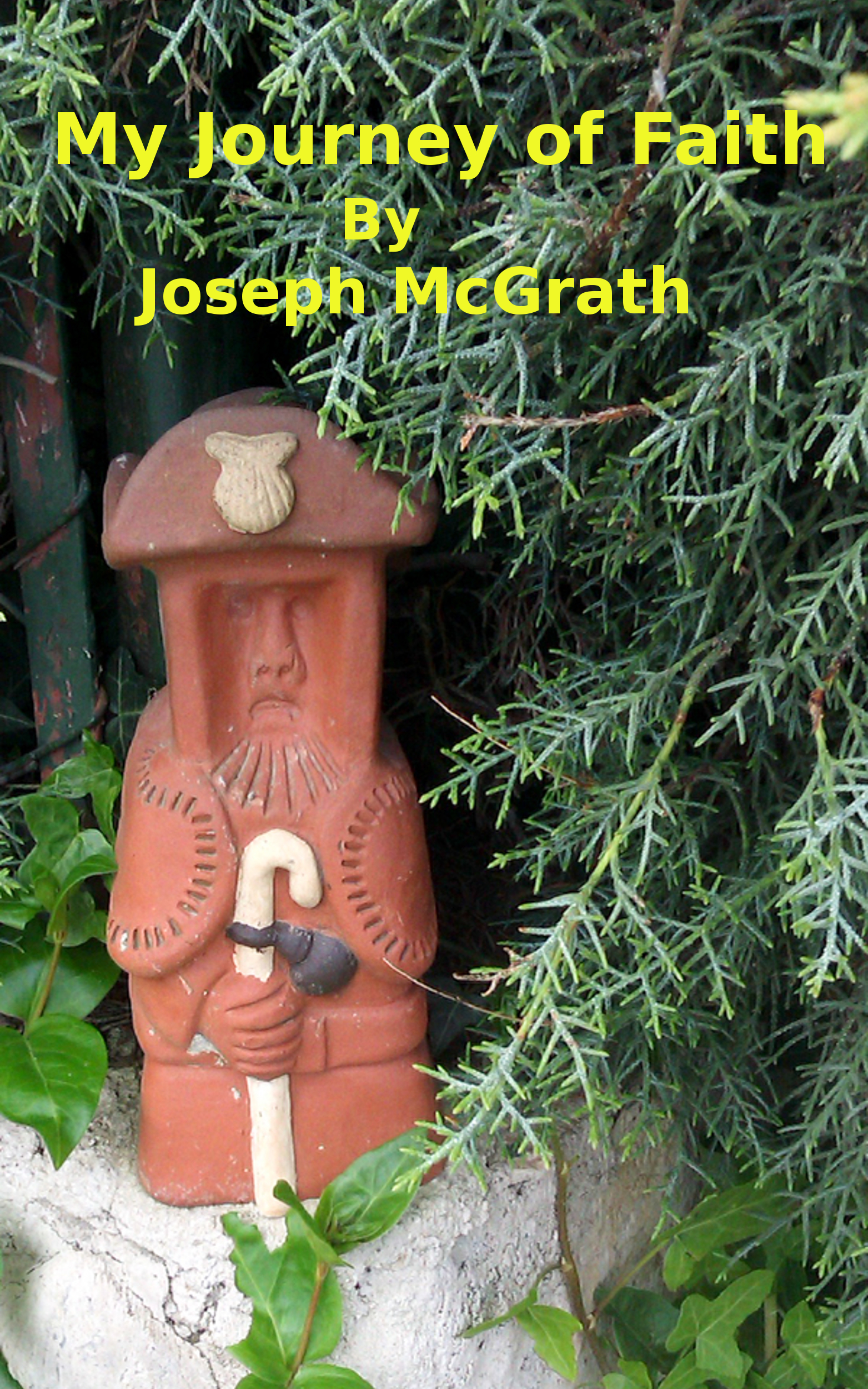
My latest Kindle publication “My Journey of Faith” is on a free offer promotion on Kindle.

The free offer runs from Friday 28th February 2014 ’till Sunday 2nd March. The book is normally priced at 99p.

Clicking HERE will take you to the book.

This will make good lenten reading, or, if it doesn’t live up to expectation it could provide you with a suitable Lenten Pennance.

Is It Time For Football To Go Away?

A goal

Ball in the net – so what?

There is much speculation about the imminent ‘Second Administration’ of Glasgow Rangers. It raises the question “Would you be sorry to see them go?” Many Celtic supporters would be sorry to lose their big hitter opponent. I would not be sorry.
Actually I would not be sorry to see Celtic and all the other football ‘clubs’ go. You might ask why a football agnostic would bother to comment. Well, it’s quite simple. I think football has become a major threat to our world. It could be described as the poor man’s Scientology.
What is football about? It’s about kicking a plastic ball into a nylon net. It’s also about stopping the other guy kicking a plastic ball into a nylon net. What’s so bad about that? Well, what’s so good about it? Football has gone beyond any rational game. It has become the focus for all sorts of tribal nonsense. It has become the home for all those who need to belong to something; preferably something that doesn’t require any difficult beliefs, specialist knowledge or understanding.
You can go along and join in the singing and feel part of the community. It’s almost like a religion, but less complicated. Well, so what? What’s so bad about that? Was it Karl Marx who said that religion was the opiate of the people? Well now it’s football. The papers are full of it. The television must show it. And, all the time, the real issues in our world can be sidelined. The economy is in the septic tank and we can happily pay a potato over £300,000 per week to kick a ball (or so I’m told).
Our government is knocking seven bells out of the poorest in society and it’s football managers who get the sack. Keep people concentrating on trivia as if their lives depend on it and you can get away with murder. Football is escapism; but there’s no escaping the reality that we have lost all sense of proportion and we are allowing ourselves to be kidded.
Look, there is a housing shortage! Why not build houses on all those stadia and give people a place to live? If you like football, then take a ball down to the park and kick it about. It’s as simple as that. Now I realise that these views might offend. That’s not my intention. I’d just like to inject a small slice of reality into an imaginary world.

Fings Aint Wot They Used Ta Be

Freak waves

Storms hit the coast

I don’t know if you’ve noticed , but the weather has been rather unusual recently. Storms have lashed the south coast and have destroyed the railway line to Cormwall. There are so many flooded areas in England that emergency services are stretched beyond their limits. Even the army is overstretched.

That’s not all. The East coast of the USA and Canada has been suffering a winter like no other. Some places have seen snow for the first time. Travel has been almost impossible at times. Meanwhile California is suffering its worst ever winter drought. I was in San Francisco over a year ago and my cousin Matt McGhaa was explaining that their summer water supply is dependent on the winter snows on the hills melting and topping up their reservoirs. Not much hope of that this year.

Australia has been on fire again.

Do you think the climate may be changing?

Do you think it might not be for the better?

Do you think the government has taken this seriously?

I don’t really want to be a prophet of doom, but the way things are looking I think we should start considering some changes around here. We could start with a government that seems to have missed the predictions and gut the money for flood protection.

The 50% Line

The clowns

Boris and Dave; who should resign first?

London Mayor, Boris Johnston has complained about the current Underground strikes in the capital. He argues that it is not right for a union to call a strike without the backing of 50% of the members, not the voting members but 50% of the membership.

There is a certain logic to his demand. It does sound democratic. It sounds absolutely reasonable. Who could refuse such a request. It is, in fact, a very democratic principle. There would be no need to demand that the unions adopt this principle if it became an integral part of our democracy.

General elections would seen to be more than fair if the winner had to poll 50% of the electorate; not 50% of the votes, but 50% of those eligible to vote. There would arise a slight problem; fewer than 50% of the electorate regularly vote. It might be impossible to elect a government then. You might think that would be no bad thing when we consider the amateur bunch (Boris’ pals) who are running the show now.

Well done Boris! another load of absolute, unconsidered nonsense put out as political speak.

The Way of the Cross 1

Strangers to Christianity often wonder at the symbolism we use. The cross is a reminder of Christ’s violent and ignominious death, a failure in human terms. Similarly, the way of the cross must seem strange to them. We follow the last steps of Jesus as He carries His cross to the place of execution. Why would we wish to remember that?

Of course, as Christians, we understand the significance of this event and we are charged to take up our cross and follow. The Stations of the Cross which we are familiar with originated in the Via Dolorosa followed by pilgrims to Jerusalem. They retraced the path Jesus followed to His crucifixion.

Today we are following a tradition which is reputed to have started with Saint Francis of Assisi who made this a devotion in churches. We don’t need to go to Jerusalem to retrace Our Lord’s last steps we can do it in our own parish. It is so much an accepted part of Catholic life that I have never given much thought to its origins or deeper meanings.

This time last year I was making my preparations for my attempt at the Camino, a testing pilgrimage. When I set off eventually I passed through Lourdes and had a passing thought about starting from there. The train moved off and the thought went. At the end of last year I returned to Lourdes for the feast of the Immaculate Conception, a less strenuous pilgrimage.

On that feast day we had Mass in the grotto followed by The Stations in the underground basilica. We were led by Father John Ahern and his commentary had a lasting effect on me. The basilica was dark and cold on that December morning. Perhaps the strange surroundings led me to think again about the Stations as a pilgrimage.

That’s where I’m going this year. I’m going to take each station in turn and see what I find. I hope you can come along.

The First Station – Jesus is condemned to death

I start by looking at what we are told in the Gospels. All four evangelists agree that Jesus was condemned to death by Pontius Pilate. They go to some length to show that Pilate was reluctant to do this. He said he could find no case against Jesus that merited death. The crowd applied pressure. They howled him down. They applied political threats. They claimed that Jesus’ claim to be a king was a threat to Caesar, Pilate’s boss.

Pilate reluctantly gave in and condemned Jesus to death. In Matthew’s gospel we learn that he washes his hands of Jesus’ blood. Matthew goes further to tell us that the people say “Let his blood be on us and our children.”

So who is guilty of Jesus’ death? The debate resurfaces from time to time. In recent years the Mel Gibson film “The Passion of The Christ” caused furore and accusations of anti-Semitism. Were the Jews to blame or was it the Romans? It is an interesting debate, but I think it misses the point. I was always taught that Jesus died for our sins. He died to redeem us. If there is any blame going then some of it must, surely come my way.

The focus of this station is not on who is to blame. We are asked to look at this situation and imagine what we would have done if we had been there. If I was one of the crowd would I have cried out “Crucify him!” just like the others? It might have proved to be a dangerous thing to do.

If I had been in Pontius Pilate’s place how would I have reacted? Pilate was a powerful man. He had a Roman army at his disposal. He could have sorted out the crowd easily. Pilate was governor to calm down Jerusalem. He didn’t want to stir up crowds. He knew Jesus was innocent and a victim of jealousy. Would I have acted differently? Would I stand up for truth in the face of displeasing my ruler and probably losing my job?

Well, that was then and this is today. It would be easy to say I would have been a man of principle and would have stood for justice. What would I do in a similar situation today? There are innocent people suffering and dying in unjust situations. In Africa there are poor farmers who will remain poor no matter how hard they work because the price of the tea or coffee they grow is decided by the dealers in the rich countries. I buy that tea and coffee. When am I standing up against injustice?

Asylum seekers in our country face inhuman treatment sometimes. I read today of an eighty four year old man in a detention centre for asylum seekers who died in handcuffs. Doctors had declared him to be unfit for detention or deportation but he died, having been in handcuffs for almost five hours. When did I stand up and speak out against inhuman treatment of people in my country?

Some might cite the abortion scandal in our country as another example of killing the innocent while we ignore it. In the light of these things I’m not sure that I could claim to act any differently than Pilate or the crowd who condemned Jesus. Perhaps that’s the point of the first station. It invites us to look, not at Pilate and the crowd, but at ourselves.

The Way of the Cross is a pilgrimage of sorts and it should enable me to see things in a different light. It should enable me to see myself more clearly, let me see who I really am. I think I must take stock and decide whether I want to be one of the crowd or stand up for justice.

Fortunately there are ways of taking action now that may not have been available in the past. If I want to take action against injustice I can join one of the many groups or organisations that combat injustice. I can become a campaigner with Justice and Peace or help organisations that work to help the poor like Mission Matters or Aid to the Church in need. I could volunteer to work for the poor with the Society of Saint Vincent De Paul.

There are lots of ways I could stand up for justice. One of the most effective ways is, of course, through prayer. Prayer must not be seen as an easy way out. Real prayer is not a quick Hail Mary for the poor. Real prayer for justice must be regular and unceasing. There are lots of prayer options for me. Perhaps I could look back to where I started, in Lourdes. The wee shops opposite the grotto are loaded down with rosaries, and for good reason. Regularly praying the rosary (not the mad dash through the decades) could provide me with an effective and powerful means to stand out from the crowd.

Just as importantly, I must become more observant. I should be able to spot injustice, be it at work, at home or in the public arena. I must become prepared to do something about it.

Joseph McGrath

My New Book On Kindle

Book Cover

Look out for this cover

My latest publication is now available on Kindle. My Journey of Faith pulls together my colum articles from 2013 with a bit more detail on my attempt on the Camino. It was inspired by Pope Benedict XVI and his ‘Year of Faith’.

It is going live now and should soon be available to borrow free for Premuim members of Amazon.

My New Series Starts Today

My monthly column in the Scottish Catholic Observer starts again with a new series on the Way of The Cross. This follows on from last year’s series on a Journey of Faith.

How much do you know about the Way of The Cross? In this series I’ll be looking at what meaning it holds for me. Why not join me every fourth fFriday in the month?

The full text will appear here next week, as usual.